

Now Reading: Understanding the Standard Size 5 Soccer Ball Diameter
-
01
Understanding the Standard Size 5 Soccer Ball Diameter


Have you ever wondered what makes a soccer ball perfect for a professional match or even just a competitive game with friends? It’s not just about the brand or the color; it’s about the science and standards behind its construction. A key part of this is the 5 soccer ball diameter, which is the official size used in professional leagues and international tournaments worldwide.
Understanding the specifics of this standard size can give you a new appreciation for the game and help you choose the right equipment. Whether you’re a player, a coach, or a curious fan, knowing why the size 5 ball is the universal standard is essential. This guide will walk you through everything you need to know, from official regulations to how the diameter affects your game.
Key Takeaways
- A regulation size 5 soccer ball has a diameter between 22 and 23 centimeters (8.65 to 9.06 inches).
- The circumference must be between 68 and 70 centimeters (27 to 28 inches).
- The 5 soccer ball diameter is the standard for players aged 12 and up, including all professional adult leagues.
- FIFA has strict regulations covering the ball’s size, weight, pressure, and roundness to ensure fair play.
- The materials and construction of a size 5 ball, such as the bladder and panel design, significantly impact its performance.
What is the Official Size 5 Soccer Ball Diameter?
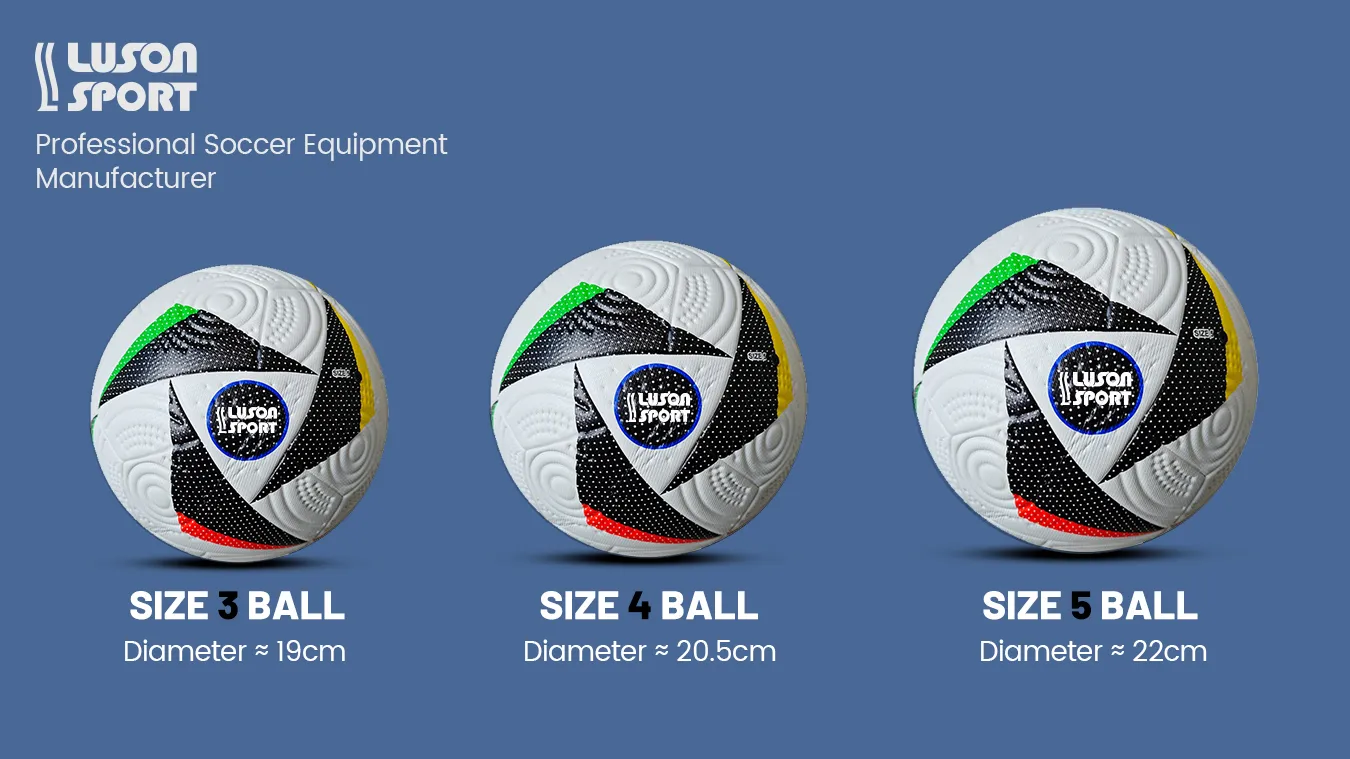
When we talk about the standard soccer ball used by professionals and serious players, we are referring to a size 5 ball. The governing bodies of soccer, like FIFA (Fédération Internationale de Football Association), have set strict rules for its dimensions to ensure consistency and fairness in every match. The official 5 soccer ball diameter must be between 22 and 23 centimeters (cm), which translates to approximately 8.65 to 9.06 inches.
This specific measurement isn’t arbitrary. It’s the result of decades of evolution in the sport, designed to create a ball that is perfect for adult players in terms of control, aerodynamics, and kicking power. A smaller diameter might be too fast and difficult to control, while a larger one would be slow and clumsy. The defined range allows for minor variations between manufacturers but ensures that every official match ball performs within a predictable and fair standard. So, the next time you see a free-kick expert curl a ball into the top corner, remember that the precise 5 soccer ball diameter plays a crucial role in making that amazing shot possible.
Circumference and Its Relation to Diameter
While diameter is a key measurement, the official regulations from FIFA primarily specify the ball’s circumference. The circumference of a size 5 soccer ball must be between 68 and 70 centimeters (27 to 28 inches). Diameter and circumference are directly related through the mathematical formula: Circumference = π (pi) × Diameter.
Using this formula, we can see how the specified circumference range directly results in the required diameter. For example, a ball with a 68 cm circumference has a diameter of approximately 21.65 cm, and a ball with a 70 cm circumference has a diameter of about 22.28 cm. This mathematical relationship ensures that as long as a ball meets the circumference standard, its 5 soccer ball diameter will fall within the acceptable range. This consistency is vital for players, who develop a feel for the ball’s size, allowing them to dribble, pass, and shoot with precision.
FIFA’s Regulations for a Size 5 Ball
FIFA’s role is to make sure that soccer is played fairly across the globe, and that includes the equipment. The Laws of the Game, specifically Law 2, outline the precise specifications for the ball. These rules go far beyond just the 5 soccer ball diameter and circumference.
The regulations are incredibly detailed, ensuring every official match ball is nearly identical in performance, regardless of the brand. This prevents any team from gaining an unfair advantage from a ball that is lighter, bouncier, or shaped differently. FIFA-approved balls undergo rigorous testing to earn their certification mark. This mark signifies that the ball meets the highest standards of quality and performance, making it suitable for top-tier competitions like the World Cup. These strict standards ensure that the focus of the game remains on player skill and teamwork.
Official Weight Requirements
Alongside its dimensions, the weight of a size 5 soccer ball is critical. According to FIFA regulations, at the start of a match, the ball must weigh between 410 and 450 grams (14 to 16 ounces). This weight is carefully balanced with the 5 soccer ball diameter to provide the ideal feel and flight characteristics. A ball that is too light might be overly affected by wind and difficult to control, while a ball that is too heavy would require more force to kick and could increase the risk of injury. The specified weight range ensures the ball responds predictably to a player’s touch, whether it’s a soft pass or a powerful shot.
Pressure Specifications
A soccer ball’s performance is heavily dependent on its internal air pressure. FIFA specifies that a size 5 ball must be inflated to a pressure between 0.6 and 1.1 atmospheres (600 – 1,100 g/cm²) at sea level. This is equivalent to 8.5 to 15.6 pounds per square inch (PSI).
Proper inflation is crucial. An under-inflated ball will feel sluggish, won’t travel as far, and will have poor bounce. It can also be harder to control when dribbling. Conversely, an over-inflated ball will be too hard and bouncy, feeling like a rock when kicked and increasing the risk of it flying uncontrollably. Referees check the ball’s pressure before every official match to ensure it meets these standards, guaranteeing a fair and safe playing experience.
Testing for Shape and Roundness
A soccer ball must be perfectly spherical to roll true and fly predictably. To enforce this, FIFA conducts a roundness test. The ball’s diameter is measured from multiple points, and the variation between the measurements cannot exceed 1.5%. This stringent test ensures that the ball doesn’t have any lumps or an oblong shape, which could cause it to move erratically. The consistent roundness, combined with the standard 5 soccer ball diameter, allows players to master complex skills like swerving shots, as they can rely on the ball to behave as expected. This precision is a hallmark of high-quality soccer equipment.
The Importance of the Size 5 Soccer Ball Diameter in Gameplay
The 5 soccer ball diameter is not just a number in a rulebook; it has a direct and significant impact on how the game is played. For adult and youth players aged 12 and up, this size provides the perfect balance of surface area and weight for developing advanced skills. The larger surface area, compared to smaller youth balls (like sizes 3 and 4), allows for a greater contact area with the player’s foot. This makes it easier to apply spin to the ball, enabling players to execute curling free-kicks, swerving passes, and chipped shots with greater control. The diameter also influences how players receive the ball, allowing for more precise trapping and control with their feet, chest, or head.
Furthermore, the aerodynamics of a size 5 ball are optimized for long-distance passing and shooting. Its size and weight allow it to cut through the air with stability, maintaining its trajectory over longer distances. This is why you see professional players making incredible 50-yard cross-field passes with pinpoint accuracy. The standardized 5 soccer ball diameter ensures a level playing field where skill, not equipment variance, determines the outcome.
Impact on Ball Control and Dribbling
When dribbling, a player needs the ball to respond predictably to every touch. The 5 soccer ball diameter provides a substantial enough surface for players to use different parts of their foot—inside, outside, and laces—to manipulate the ball’s direction and speed. A smaller ball would be quicker and perhaps harder to keep close, while a larger one would be clunkier and slow down a player’s movement. The size 5 standard strikes an ideal balance, allowing for both tight, close-control dribbling in crowded spaces and longer, more powerful touches when running into open space. This consistency helps players develop muscle memory and confidence in their footwork.
Influence on Shooting and Passing
The 5 soccer ball diameter is fundamental to shooting and passing techniques. When striking the ball for a powerful shot, the larger surface area allows a player to make solid contact with the “sweet spot” of the ball, transferring maximum energy for speed and distance. For passes, the diameter helps players gauge the amount of force needed for different distances. A soft touch with the inside of the foot on a size 5 ball will travel predictably to a nearby teammate, while a driven pass with the laces will cover ground quickly. The standardization of the ball’s dimensions allows players to train and perfect these techniques, knowing the ball will react the same way in a practice session or a championship match.
Historical Evolution of the Soccer Ball
The soccer ball has come a long way from its early days. The first “balls” were often animal bladders, which were irregular in shape and size. The invention of vulcanized rubber by Charles Goodyear in 1855 was a turning point. It allowed for the creation of balls that were more durable and held their shape. In 1863, the English Football Association (FA) established the first set of official rules, which included specifications for the ball’s size and weight.
These early regulations were the foundation for the modern standards we have today. Over the decades, the materials and construction have evolved dramatically—from heavy, water-absorbent leather to lightweight, water-resistant synthetic materials. However, the fundamental dimensions, including what would become the standard 5 soccer ball diameter, have remained relatively consistent for over a century. This evolution reflects a continuous search for the perfect ball that balances durability, performance, and player safety, a journey that has led us to the high-tech marvels used in today’s game.
From Leather to Synthetic Materials
Early soccer balls were made of stitched leather panels with an animal bladder inside. A significant problem with these balls was their tendency to absorb water. On a rainy day, a leather ball could double in weight, making it heavy, hard to kick, and dangerous to head. The introduction of synthetic materials in the 20th century revolutionized ball design.
Modern soccer balls use synthetic leather, often polyurethane-based, which is far more durable and water-resistant. This ensures the ball maintains its specified weight and performance characteristics even in wet conditions. The shift to synthetic materials also allowed for new construction methods, such as thermally bonded panels instead of stitching, which creates a more perfectly round ball with fewer seams. This innovation has further enhanced the consistency of the 5 soccer ball diameter and its overall performance. For more insights on manufacturing and innovation, platforms like Forbes Planet often cover advancements in sports technology.
Comparing Ball Sizes: Why Size 5 is the Standard
Soccer balls come in different sizes to suit players of different ages and skill levels. While size 5 is the universal standard for adults, smaller sizes play a crucial role in player development.
|
Ball Size |
Recommended Age Group |
Circumference |
Diameter (approx.) |
Weight (approx.) |
|---|---|---|---|---|
|
Size 1 |
All Ages (Skills/Mini) |
46-51 cm (18-20 in) |
14.6-16.2 cm |
~200 g |
|
Size 2 |
Ages 3-5 (Skills) |
52-56 cm (20-22 in) |
16.5-17.8 cm |
~210-225 g |
|
Size 3 |
Ages 5-8 |
58-61 cm (23-24 in) |
18.5-19.4 cm |
~300-340 g |
|
Size 4 |
Ages 8-12 |
63.5-66 cm (25-26 in) |
20.2-21.0 cm |
~350-390 g |
|
Size 5 |
Ages 12 and up |
68-70 cm (27-28 in) |
22-23 cm |
410-450 g |
This tiered system allows young players to learn the game with a ball that is appropriately sized for their bodies. Using a ball that is too large or heavy can hinder skill development and even lead to injury. As players grow and develop strength and coordination, they graduate to the next size up, culminating in the standard size 5 ball when they are ready for full-field, 11v11 play. The 5 soccer ball diameter represents the final step in this developmental pathway.
Why Younger Players Use Smaller Balls
Using a smaller, lighter ball is essential for the development of young soccer players. For children under 12, a size 5 ball is simply too big and heavy. Kicking a ball that is too large can force them to use improper technique, potentially leading to bad habits or even injury.
- Better Skill Development: A smaller ball is easier for a child to control, dribble, and shoot. It allows them to learn proper form without having to compensate for excessive weight and size.
- Increased Confidence: When children can successfully handle the ball, their confidence grows. This makes the game more fun and encourages them to continue playing and practicing.
- Reduced Risk of Injury: Kicking a ball that is too heavy can put undue strain on a child’s joints and muscles. Appropriately sized balls ensure a safer playing experience.
The progression through ball sizes is a thoughtful process designed to nurture young talent and prepare them for the day they are ready to master the standard 5 soccer ball diameter.
Choosing the Right Size 5 Soccer Ball
Not all size 5 soccer balls are created equal. They can be broadly categorized into three types: professional match balls, match balls, and training balls. The one you choose depends on your budget and level of play.
Professional Match Balls: These are the highest quality balls and are FIFA-approved. They use premium materials, have thermally bonded panels for perfect roundness, and offer the best performance. They are also the most expensive.
Match Balls: These are high-quality balls often used for league and school matches. They are typically FIFA-inspected or meet similar standards (like NFHS in the US). They offer excellent performance and durability at a more moderate price point.
Training Balls: These balls are built for durability and are designed to withstand constant use on various surfaces. Their outer casing is tougher, and they are the most affordable option. While they may not have the same elite performance feel as a match ball, they are perfect for practice. When buying a ball, always check that its 5 soccer ball diameter and weight conform to official standards.
Frequently Asked Questions (FAQ)
1. What is the diameter of a size 5 soccer ball in inches?
A regulation 5 soccer ball diameter is between 8.65 and 9.06 inches. The official rules primarily state the circumference (27-28 inches), from which the diameter is derived.
2. Is a size 5 ball used in the World Cup?
Yes, the size 5 ball is the official, standard size used in all professional competitions, including the FIFA World Cup, the UEFA Champions League, and all major domestic leagues.
3. At what age should a player start using a size 5 ball?
Players typically transition to a size 5 soccer ball around the age of 12. This aligns with the move to playing on a full-size field and in 11v11 formations.
4. How do I check the pressure of my soccer ball?
You need a pressure gauge to check the pressure accurately. The recommended pressure (usually in PSI or bar) is often printed on the ball itself, near the inflation valve. For a size 5 ball, it’s typically between 8.5 and 15.6 PSI.
5. Does the panel design affect the ball’s performance?
Absolutely. The traditional 32-panel design (composed of 20 hexagons and 12 pentagons) was the standard for decades. However, modern balls use fewer, larger panels that are often thermally bonded. This reduces the number of seams, creating a more spherical and aerodynamic ball that offers a more consistent and powerful flight path.
Stay Informed With the Latest & Most Important News
Previous Post
Next Post










Advertisement