

Now Reading: Rediscovering Lancelot Ribeiro: An Indian Modernist Master
-
01
Rediscovering Lancelot Ribeiro: An Indian Modernist Master

Key Takeaways
- Lancelot Ribeiro was a pioneering modernist painter known for his innovative use of acrylic paints and polyvinyl acetate (PVA).
- He was the half-brother of the famous artist Francis Newton Souza and a key figure in the Indian émigré art scene in London.
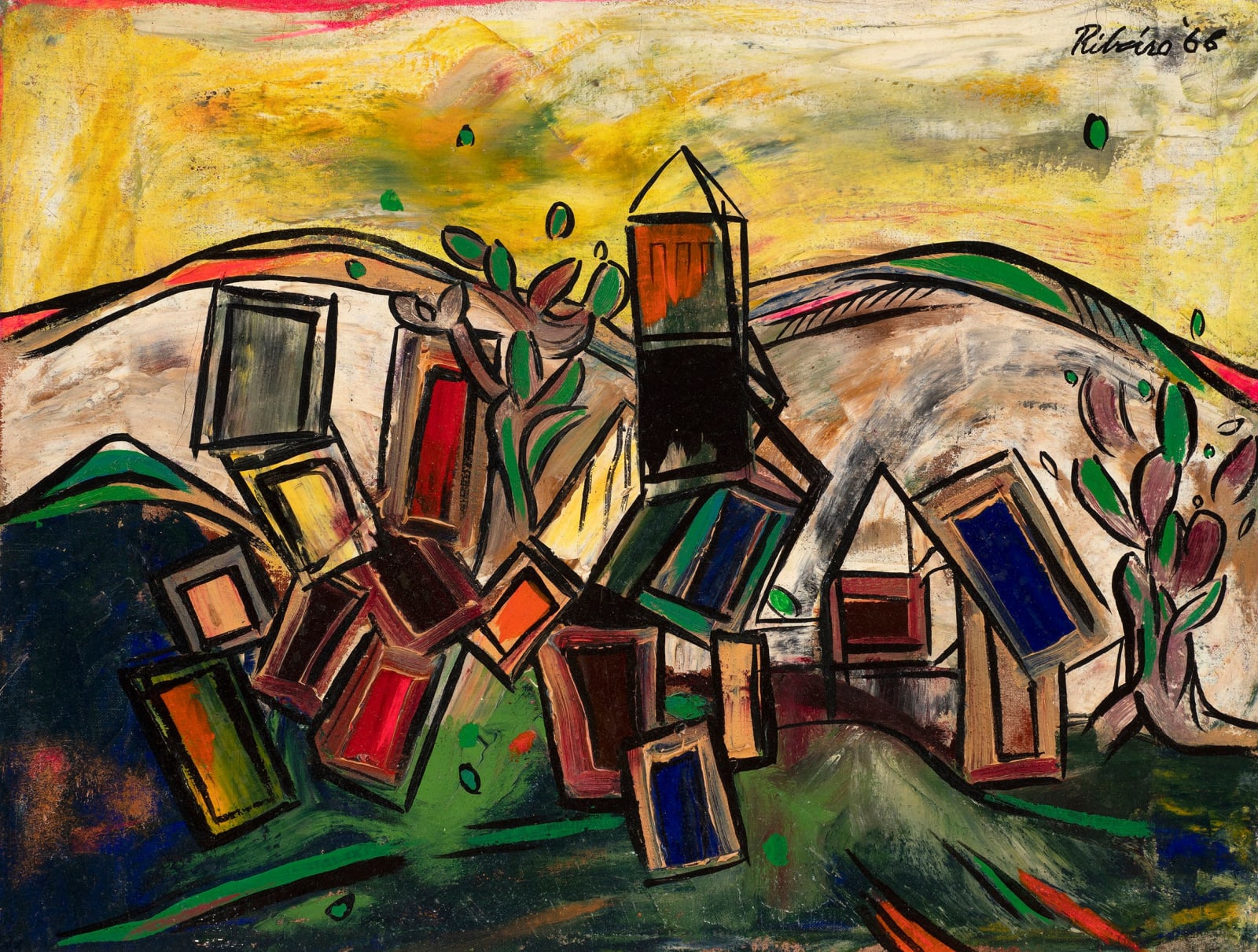
- His work often featured jagged landscapes, stylized heads, and vibrant, jewel-like colors.
- Despite financial struggles and health issues, Ribeiro remained dedicated to experimenting with new mediums and textures throughout his life.
- Recent retrospectives have helped bring his unique contributions to the forefront of modern art history.
When we talk about modern art, certain names immediately jump to mind. We think of Picasso, Dali, or maybe Warhol. But the history of art is filled with incredible talents who didn’t always get the spotlight they deserved while they were alive. One such fascinating figure is Lancelot Ribeiro, an artist whose vibrant colors and restless experimentation make him a true hidden gem of the 20th century.
Imagine an artist who wasn’t just satisfied with painting a picture but wanted to change the very chemistry of the paint itself. That was Ribeiro. He was an innovator, a struggler, and a visionary who bridged the gap between his Indian heritage and the bustling art world of London in the 1960s. In this deep dive, we are going to explore the life, the science, and the sheer beauty behind the work of Lancelot Ribeiro. Whether you are an art student or just someone who loves a good story of perseverance, there is something in his journey for you.
Who Was Lancelot Ribeiro?
Lancelot Ribeiro was an Indian modernist painter who spent a significant portion of his life living and working in London. Born in 1933 in Bombay (now Mumbai), India, he grew up in a world that was rapidly changing. He wasn’t just any aspiring artist; he came from a family with deep artistic roots. His half-brother was the incredibly famous Francis Newton Souza, one of the founders of the Progressive Artists’ Group in India.
While Souza was known for his raw, sometimes shocking imagery, Lancelot Ribeiro carved out a different path. He was quieter, more analytical, but just as passionate. He moved to London in the 1950s, joining a wave of Indian artists looking for new opportunities in the West. His life wasn’t easy. He faced the challenges of being an immigrant, financial instability, and the daunting task of making a name for himself in a crowded art scene.
Despite these hurdles, Ribeiro created a stunning body of work. He is best known for his landscapes and portraits that look almost like stained glass windows—filled with bold, black lines and glowing colors. But more than just his style, it was his scientific approach to paint that set him apart. He wasn’t afraid to mix chemicals and try things that traditional painters would never dream of doing.
Early Life in Bombay and Goa
The story of Lancelot Ribeiro begins in the vibrant, chaotic, and colorful settings of Bombay and Goa. He was born into a Roman Catholic family, which played a significant role in his visual language. The imagery of the church—the stained glass, the statues, the dramatic architecture—would later seep into his paintings in unexpected ways.
Growing up, Ribeiro was surrounded by the lush landscapes of Goa. If you look closely at his later work, you can see memories of Goa’s spikey palm trees, old whitewashed churches, and rolling hills. However, his early life wasn’t just about beautiful scenery. It was also about family dynamics. Living in the shadow of a brilliant but dominating older brother like F.N. Souza must have been tough. Souza was already making waves in the art world while Ribeiro was just starting to figure out his path.
Initially, Ribeiro didn’t even plan to be an artist. He actually studied accountancy! It’s hard to imagine a man who would later create such wild, expressive paintings sitting at a desk crunching numbers. But that analytical brain would eventually help him when he started experimenting with the chemical composition of paints. In the late 1950s, he decided to leave the numbers behind and follow his brother to London to pursue art seriously.
The Move to London: A New Beginning
Moving to London in 1962 was a massive cultural shift for Lancelot Ribeiro. London in the ’60s was swinging—it was the era of the Beatles, mini-skirts, and a cultural revolution. But for an Indian immigrant artist, it was also a cold, grey, and difficult place. He lived in North London, often in cramped conditions, trying to find warmth both literally and artistically.
The London art scene was competitive. While his brother Souza had already found success, Ribeiro had to start from scratch. He took classes at St. Martin’s School of Art, honing his skills. During this time, he began to develop his own voice. He didn’t want to just copy the European masters, nor did he want to simply paint “Indian” subjects to please exotic-seeking galleries. He wanted to create something universal.
This period was crucial for his development. He started exhibiting his work, and people began to take notice. His early oils were thick and expressive, but he soon found that oil paint was too slow for his racing mind. He needed a medium that could keep up with his ideas. This need for speed and texture would lead him to his most significant breakthrough: the use of acrylics and PVA.
The Scientist of Color: Experimenting with PVA
If there is one thing that defines the legacy of Lancelot Ribeiro, it is his obsession with paint chemistry. In the 1960s, acrylic paints were new and exciting, but they were also expensive and not widely available in the quantities Ribeiro wanted. Being short on cash but high on ingenuity, he decided to make his own.
He turned to Polyvinyl Acetate (PVA)—yes, the same stuff found in school glue! He realized that PVA could act as a binder for pigments. It dried fast, it was plastic, and it was flexible. This allowed him to paint quickly, layer upon layer, without waiting days for oil paint to dry. This was revolutionary for his style.
- Speed: He could finish paintings in a single burst of energy.
- Texture: He could build up thick, sculptural layers that stood off the canvas.
- Transparency: He could create glazes that looked like jewels or stained glass.
He didn’t just stop at using PVA; he constantly tweaked his formulas. He documented his experiments meticulously, noting which mixtures cracked, which ones stayed flexible, and which ones held color best. In many ways, Lancelot Ribeiro was as much a chemist as he was a painter. His studio was like a laboratory filled with pots of mixed pigments and binders.
Table: Ribeiro’s Paint Experiments vs. Traditional Oil
|
Feature |
Traditional Oil Paint |
Ribeiro’s PVA/Acrylic Mix |
|---|---|---|
|
Drying Time |
Slow (Days to Weeks) |
Fast (Minutes to Hours) |
|
Texture |
Smooth to Impasto |
High relief, sculptural |
|
Flexibility |
Can crack over time |
Highly flexible, plastic-like |
|
Finish |
Glossy or Matte |
Often glossy, glass-like |
|
Cost |
Expensive |
Affordable (DIY approach) |
Landscapes of the Mind
When you look at a landscape by Lancelot Ribeiro, you aren’t looking at a postcard. You are looking at a psychological terrain. His landscapes are famously “spiky.” The trees look like jagged teeth; the hills roll like stormy waves. They are energetic and sometimes even a bit menacing, yet incredibly beautiful.
These weren’t just paintings of Goa or London; they were landscapes of his mind. He combined his memories of the Indian skyline with the stark, architectural lines of the British cityscapes he saw every day. The result was a hybrid world.
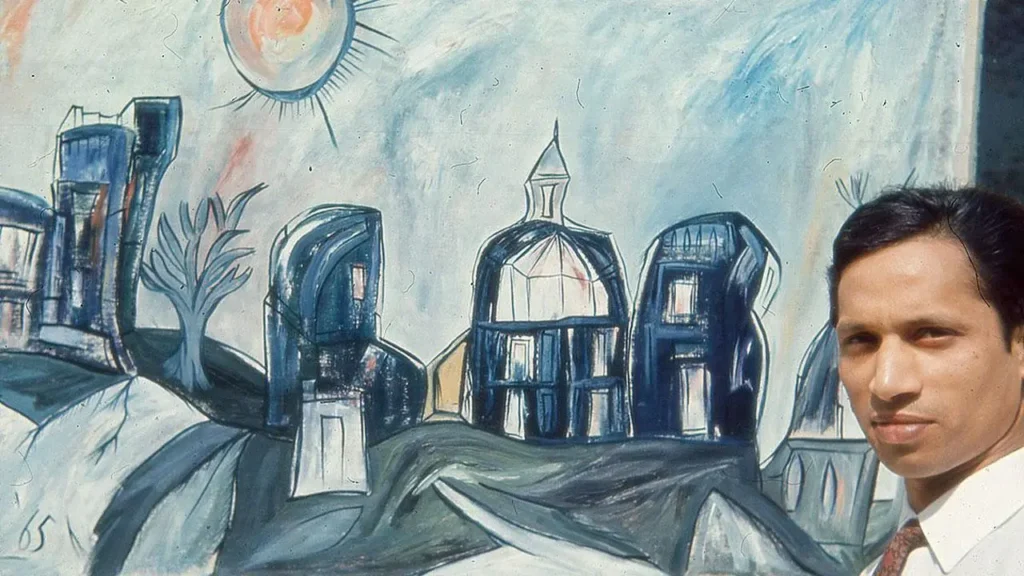
He used bold black lines to outline shapes, similar to the “cloisonné” style used in enameling or stained glass. These black lines contained the explosive colors within them. A blue wasn’t just blue; it was deep sapphire. A red was a burning ruby. This technique made his landscapes vibrate with energy. Critics have noted that his landscapes often feel like they are in motion, capturing the restless spirit of the artist himself.
The “Heads” and Portraits
Aside from landscapes, Lancelot Ribeiro was obsessed with painting heads. These weren’t standard portraits where you try to make the person look pretty. These were stylized, elongated, and often distorted faces. They had huge eyes, long necks, and strange, alien-like features.
These heads were influenced by several sources:
- Roman Catholic Iconography: The saints and martyrs he saw in churches as a child.
- Indian Classical Art: The stylization found in ancient sculptures and miniatures.
- Modernist Anxiety: The feeling of alienation and complexity in the modern world.
Sometimes the heads were humorous; sometimes they were tragic. But they were always unmistakably Ribeiro. He would often paint them in groups, or as singular, lonely figures staring out from the canvas. The use of his special PVA mixtures allowed him to give these faces a 3D quality, where the eyes or noses would literally bulge out from the surface, adding a tactile element to the viewing experience.
Struggles and Challenges
It is important to understand that the life of Lancelot Ribeiro was not a smooth ride to fame. For much of his career, he struggled financially. Being an artist is tough, but being an immigrant artist in the mid-20th century added extra layers of difficulty. He often had to rely on the support of family and friends.
He also had a complicated relationship with the art market. While his brother Souza was a master of self-promotion, Ribeiro was more reserved. He didn’t play the “game” of the art world as well. There were times when he felt overshadowed by his brother’s massive persona.
Additionally, he faced health issues later in life. The chemicals he used, and the stress of his lifestyle, took a toll. Yet, he never stopped painting. Even when money was tight, he would find ways to create. He would paint on paper if he couldn’t afford canvas. He would mix cheaper pigments if he had to. His drive to create was stronger than his circumstances.
Why Was He Overlooked?
You might wonder, if he was so good, why isn’t he as famous as Picasso? Several reasons contributed to this:
- The Shadow of Souza: Being the brother of a superstar artist can be a double-edged sword. It opens doors but also invites constant, unfair comparison.
- Changing Trends: In the 70s and 80s, the art world shifted towards conceptual art and minimalism. Ribeiro’s expressive, figurative style fell somewhat out of fashion.
- Lack of Representation: Without a big, powerful gallery pushing his work constantly, it was easy to slip through the cracks of history.
The Revival: 2010 Retrospective and Beyond
Fortunately, the story of Lancelot Ribeiro has a happy turning point. After he passed away in 2010, his family, particularly his daughter Marsha Ribeiro, worked tirelessly to preserve and promote his legacy. They organized his vast archive of works, letters, and experiments.
This led to a major retrospective exhibition titled “Restless Line” at the British Museum and other venues. Suddenly, critics and the public rediscovered him. They saw the brilliance of his chemical experiments and the unique power of his imagery.
It turns out that Ribeiro was ahead of his time. His use of acrylics anticipated a major shift in painting materials. Today, he is recognized not just as “Souza’s brother” but as a master in his own right. Museums like the Victoria and Albert Museum (V&A) in London now hold his works in their collections. This revival ensures that Lancelot Ribeiro takes his rightful place in the history of global modernism.
Artistic Techniques and Style Breakdown
To truly appreciate Lancelot Ribeiro, we need to break down his specific style elements. If you walked into a gallery, how would you spot a Ribeiro painting?
1. The “Cloisonné” Effect
As mentioned earlier, he used thick black lines to separate colors. This mimics the look of stained glass or enamel work. It gives the paintings a solid, structured feel, even when the subjects are abstract.
2. Jewel-Like Colors
Because of his PVA medium, his colors have a high gloss and deep saturation. He loved blues, purples, crimsons, and ochres. The transparency of the medium allowed light to bounce through the layers, making the paintings glow.
3. Texture is King
Ribeiro’s paintings are not flat. If you could touch them (which you shouldn’t in a museum!), you would feel bumps, ridges, and valleys. He treated paint like clay, molding it on the canvas.
4. Distorted Figures
His human figures are rarely realistic. They are elongated, twisted, or simplified. This was his way of expressing emotion rather than physical reality. A stretched neck might show elegance; a twisted face might show pain.
Frequently Asked Questions (FAQs)
Q: Was Lancelot Ribeiro related to Francis Newton Souza?
A: Yes, Lancelot Ribeiro was the half-brother of F.N. Souza. They shared a mother but had different fathers. While they were close, they also had a complex, competitive relationship as artists.
Q: What medium did Lancelot Ribeiro famous use?
A: He is most famous for using acrylics and Polyvinyl Acetate (PVA). He experimented heavily with mixing PVA glue with pigments to create his own fast-drying, textured paints.
Q: Where can I see his artwork?
A: His works are held in collections such as the Victoria and Albert Museum in London, the British Museum, and various private collections globally. Retrospective exhibitions are also held periodically.
Q: Did he only paint?
A: While painting was his primary focus, he also produced drawings and wrote poetry. His creative output was diverse, but his painted canvases remain his most enduring legacy.
Q: Why are his landscapes “spiky”?
A: The “spiky” nature of his landscapes is a stylistic choice representing the jagged, energetic, and perhaps unsettled nature of the world as he saw it. It combines memories of Goan vegetation with a modernist architectural style.
The Connection to Indian Modernism
Lancelot Ribeiro is a key piece in the puzzle of Indian Modernism. This movement was all about Indian artists finding a voice that was independent of British colonial academic art. Artists like Souza, Raza, and Husain were the superstars of this movement.
Ribeiro belongs to this lineage but offers a diaspora perspective. He represents the Indian artist abroad—someone negotiating two cultures. His work bridges the gap between the heat and color of India and the cool, analytical trends of Western art. He shows us that Indian Modernism wasn’t just something that happened in Mumbai or Delhi; it was a global phenomenon that took place in London studios too.
For anyone interested in global art history, studying Lancelot Ribeiro is essential. He proves that innovation can happen anywhere, even in a small, cold flat in North London, as long as you have the vision and the bravery to experiment. For more insights into how art shapes culture and business, you might find interesting parallels on sites like Forbes Planet, which discusses global trends.
Lancelot Ribeiro’s Legacy Today
Today, the value of Lancelot Ribeiro lies not just in the price of his paintings, but in his story of resilience. He reminds us that success isn’t always immediate. Sometimes, an artist creates for the future.
His legacy is also technical. Artists today who grab a tube of acrylic paint owe a small debt to pioneers like Ribeiro who pushed the boundaries of what synthetic paints could do. He showed that plastic paints could have soul and depth.
Furthermore, his work challenges the “Euro-centric” view of art history. For a long time, people thought modern art was just something white European men did. Ribeiro, along with his contemporaries, smashed that idea. They showed that modernism was a global language, spoken with different accents.
Conclusion
Lancelot Ribeiro was a man of restless energy and profound vision. From the sunny coasts of Goa to the grey streets of London, he carried a world of color in his mind. He was a painter, a chemist, a poet, and a struggler. His life illustrates the challenges of the immigrant experience and the unyielding drive of the true artist.
His unique “stained glass” landscapes and haunting portraits are now finally getting the applause they deserve. He taught us that paint is not just color; it is a substance to be molded, experimented with, and mastered. In rediscovering Ribeiro, we rediscover a vital chapter of modern art history that celebrates innovation and cultural synthesis.
If you are an aspiring artist, let Lancelot Ribeiro be your inspiration. Don’t be afraid to mix things up—literally and figuratively. Don’t be afraid to experiment with your tools. And most importantly, never stop creating, no matter the obstacles. His art stands today as a vibrant testament to a life lived in full color.
Disclaimer: This article provides educational information about the artist Lancelot Ribeiro. It is intended for informational purposes and does not constitute financial or investment advice regarding art collection.
Stay Informed With the Latest & Most Important News
Previous Post
Next Post










Advertisement