

Now Reading: Everything You Need to Know About Using a One Rep Max Calculator
-
01
Everything You Need to Know About Using a One Rep Max Calculator

Introduction
Have you ever walked into a gym, looked at a heavy barbell, and wondered, “What is the absolute heaviest weight I could lift for just one single time?” If you are like most people who lift weights, that thought has crossed your mind. Knowing your strength limit is not just about bragging rights; it is a crucial part of designing a safe and effective workout plan. However, testing your limits physically can be dangerous if you aren’t careful. This is where a one rep max calculator becomes your best friend in the gym.
Instead of risking injury by loading up a bar until you fail, you can use math to estimate your strength. A one rep max calculator takes the weight you can lift for several repetitions and uses a formula to predict your maximum single lift. It is a smarter, safer way to track your progress. In this guide, we will dive deep into how these calculators work, why they matter, and how you can use them to get stronger without getting hurt.
Key Takeaways:
- A one rep max calculator estimates your maximum strength safely.
- Knowing your 1RM helps you choose the right weights for your workouts.
- You don’t always need to lift heavy to find your max.
- Calculators use proven formulas like Epley and Brzycki.
What Is a One Rep Max (1RM)?
Before we jump into how to use a one rep max calculator, we need to understand exactly what a “one rep max” is. In simple terms, your one rep max (often written as 1RM) is the maximum amount of weight you can lift for exactly one repetition with proper form. If you can lift it twice, it is not your one rep max. If your form breaks down and you have to cheat to get the weight up, it doesn’t count either.
Think of your 1RM as the gold standard of your current strength level. It is a snapshot of what your muscles can do when pushed to their absolute limit. Powerlifters train specifically to increase their 1RM in the squat, bench press, and deadlift. However, even if you are just trying to get fit or build muscle, knowing this number is incredibly useful. It acts as a baseline. When you know your baseline, you can measure how much stronger you are getting over weeks and months of hard work.
Why Does Your 1RM Matter?
You might be thinking, “I just want to look good and feel healthy. Why do I need to know my max?” The answer lies in how workout programs are designed. Most effective strength training programs use percentages of your 1RM to tell you how much weight to put on the bar. For example, a program might say, “Do 3 sets of 5 reps at 75% of your 1RM.” Without knowing your max, you are just guessing.
Using a one rep max calculator takes the guesswork out of your training. If you guess too low, you won’t stimulate your muscles enough to grow. If you guess too high, you risk injury or burnout. Accuracy matters. By using a calculator, you can ensure that every workout is tailored perfectly to your current strength level, maximizing your results while keeping you safe.
The Dangers of Testing Your True 1RM
Testing your actual one rep max by physically lifting the heaviest weight possible is very demanding on your body. It places massive stress on your central nervous system, your joints, and your muscles. For beginner and intermediate lifters, attempting a true 1RM test can be risky. If your form isn’t perfect, or if your muscles aren’t ready for that kind of load, you could suffer a serious injury like a muscle tear or a herniated disc.
This is why experienced coaches often recommend avoiding true 1RM testing until you have years of experience. Instead, they suggest using a one rep max calculator. These tools allow you to test your strength using a weight you can lift for 3, 5, or even 10 reps. This “sub-maximal” testing is much safer because the weight is lighter and easier to control. You get the data you need without the high risk of dropping a heavy barbell on yourself.
How Does a One Rep Max Calculator Work?
A one rep max calculator uses mathematical formulas to predict your max based on sub-maximal lifts. The idea is simple: there is a reliable relationship between the weight you lift and the number of times you can lift it. For instance, if you can lift 100 pounds for 10 repetitions, a formula can predict what you could lift for just one repetition.
These calculators typically ask for two inputs:
- Weight Lifted: The amount of weight you used for your test set.
- Repetitions (Reps): The number of times you lifted that weight before you couldn’t do another one with good form.
Once you input these numbers, the calculator crunches the data and gives you an estimated 1RM. It might also give you a chart showing what you can lift for different rep ranges (e.g., your 5-rep max or 8-rep max). It is a quick and easy way to get valuable data without spending an entire gym session testing your limits.
Popular Formulas Used
Different calculators use different math equations. While you don’t need to be a math genius to use a one rep max calculator, it helps to know the names of the formulas powering them. Here are the most common ones:
- Epley Formula: This is one of the most famous formulas, especially for people lifting heavy weights for fewer reps.
- Brzycki Formula: This is very popular and widely used in gyms and apps.
- Lombardi Formula: Another option that sometimes works better for higher rep ranges.
Most online tools will automatically pick the best formula or average the results from several of them to give you the most accurate number possible.
Step-by-Step Guide: Using a One Rep Max Calculator
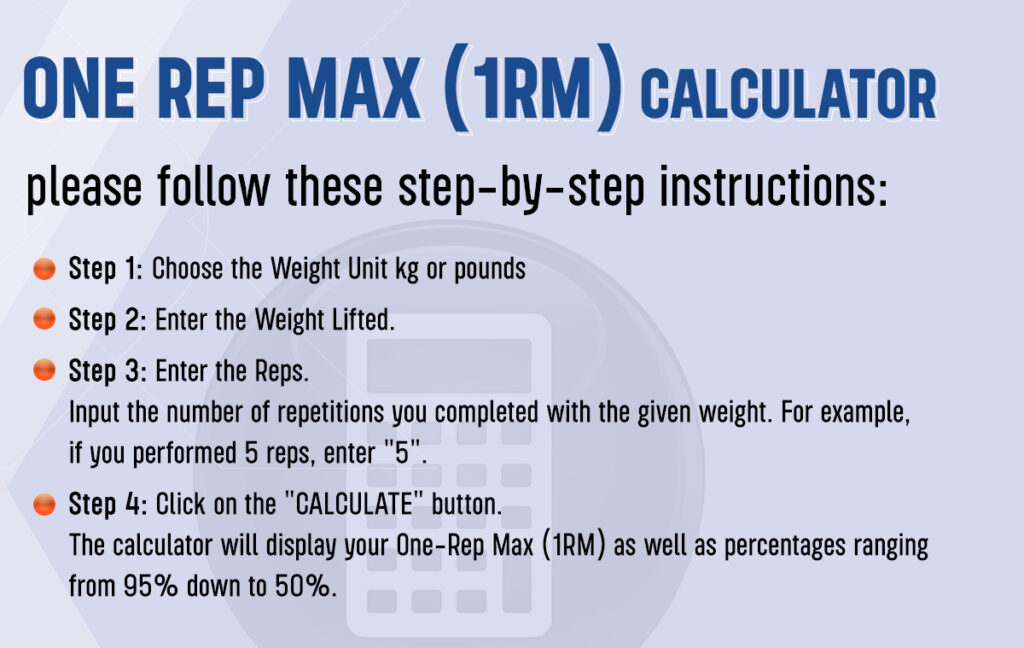
Using a calculator is easy, but getting accurate data to put into it requires a little preparation. You can’t just guess how many times you can lift a weight; you have to actually do it. Follow these steps to get the best results from your one rep max calculator.
Step 1: Choose Your Exercise
Pick a compound movement like a squat, bench press, deadlift, or overhead press. These exercises use multiple muscle groups and give the most accurate strength assessments. Isolation exercises like bicep curls are harder to calculate accurately because small muscles fatigue differently.
Step 2: Warm Up Thoroughly
Never start lifting heavy cold. Do 5-10 minutes of light cardio to get your blood flowing. Then, do several warm-up sets of the exercise you chose. Start with an empty bar and slowly add weight until you get close to your working weight.
Step 3: Perform Your Test Set
Choose a weight that is challenging but that you can lift for roughly 3 to 10 repetitions. If you can lift it more than 10 times, the calculation becomes less accurate. Perform the exercise until you cannot complete another rep with good form. This is called “failure.” Count exactly how many full reps you finished.
Step 4: Calculate
Take the weight you lifted and the number of reps you performed and plug them into a one rep max calculator. The tool will instantly tell you your estimated max.
The Benefits of Sub-Maximal Testing
We briefly mentioned that testing with lighter weights is safer, but there are other benefits too. Sub-maximal testing (testing below your max effort) is less draining. A true 1RM test can leave you feeling exhausted for days, impacting your other workouts. Using a one rep max calculator based on a 5-rep set allows you to recover quickly and get back to training the very next day.
Additionally, sub-maximal testing allows for more frequent progress checks. You can’t test your true max every week—it’s too hard on the body. But you can easily check your estimated max every few weeks using a calculator. This lets you see if your program is working. If your estimated max is going up, you are getting stronger. It keeps you motivated seeing those numbers climb without the stress of a scary heavy lift.
Understanding Different Rep Ranges
When you use a one rep max calculator, you will often see a chart breaking down your strength across different repetition ranges. Understanding these ranges helps you target specific goals. Muscles respond differently depending on how heavy the weight is and how many times you lift it.
Here is a quick breakdown of rep ranges and their goals:
|
Rep Range |
Primary Goal |
Percentage of 1RM |
|---|---|---|
|
1-5 Reps |
Strength & Power |
85-100% |
|
6-12 Reps |
Muscle Growth (Hypertrophy) |
65-85% |
|
12-20+ Reps |
Muscular Endurance |
Below 65% |
By knowing your 1RM, you can calculate the exact weight needed for these goals. If you want to build big muscles, you calculate 70-80% of your max and lift that for 8-10 reps. If you want pure strength, you calculate 90% and do triples. This precision is the secret weapon of athletes worldwide.
Accuracy of One Rep Max Calculators
Are these calculators 100% perfect? No, they are estimates. Several factors can influence the accuracy of a one rep max calculator. For example, some people have more “fast-twitch” muscle fibers, which makes them better at low reps but worse at high reps. Others have “slow-twitch” fibers and can do many reps but struggle with a heavy single.
Furthermore, the formula becomes less accurate as the reps get higher. If you plug in a set of 20 reps, the estimated 1RM might be way off. For the best accuracy, try to keep your test set between 3 and 8 repetitions. This creates a “sweet spot” where the math holds up very well against reality. Always treat the number as a guideline, not a strict rule. Listen to your body and adjust if the weight feels too heavy or too light.
Factors That Affect Accuracy
- Experience Level: Beginners may have unstable form, leading to inaccurate test results.
- Fatigue: If you are tired or sore, you won’t perform as well, skewing the numbers.
- Exercise Type: Upper body lifts sometimes calculate differently than lower body lifts.
- Mental State: Your focus and motivation during the test set play a huge role.
How to Integrate 1RM Into Your Routine
Once you have your number from the one rep max calculator, how do you use it? The best way is to plan your training cycles. This is often called “periodization.” You might spend four weeks focusing on hypertrophy (muscle growth) using 70% of your 1RM. Then, you might switch to a strength block using 85% of your 1RM.
For resources on structuring your life and fitness routines effectively, you can check out https://forbesplanet.co.uk/ for great tips. Integrating structured planning into your fitness journey is key. You can write down your percentages in a notebook or use an app. Before every workout, check your 1RM, do the math, and load the bar correctly. This stops you from “ego lifting” (lifting too heavy just to look cool) and ensures you are hitting the specific intensity needed for results.
The Epley Formula Explained
Let’s get a little technical—but keep it simple. The Epley Formula is one of the most common equations used in a one rep max calculator. It was developed by Boyd Epley in 1985. It looks like this:
1RM = Weight × (1 + (Reps / 30))
This formula assumes that for every repetition you can do, your max is slightly higher. It is known for being very accurate for people who lift recreationally. It tends to give slightly higher numbers than some other formulas, which can be good for motivation, but always be careful when attempting that weight for the first time.
Because it is simple math, you can even do this on your phone’s calculator if you don’t have an internet connection. Just remember: multiply your reps by your weight, then adjust with the division. Or, save time and just use an online tool designed for it!
The Brzycki Formula Explained
Another heavyweight in the world of lifting math is the Brzycki Formula. Created by Matt Brzycki in the early 1990s, it is slightly more conservative than Epley. The formula is:
1RM = Weight / (1.0278 – (0.0278 × Reps))
This might look complicated, but it basically reduces the estimated max slightly as reps increase. Many coaches prefer this for safety reasons. If a one rep max calculator gives you a slightly lower number, you are less likely to get crushed by a heavy barbell.
The Brzycki formula is often the default setting on many gym apps. It is widely considered reliable for rep ranges up to 10. Once you go past 10 reps, like with the Epley formula, the accuracy drops.
When Should You Retest Your 1RM?
Your strength changes constantly. If you are training hard and eating right, your strength will go up. If you take a break or get sick, it might go down. Therefore, your 1RM is not a permanent number. You need to update it regularly to keep your workouts effective.
A good rule of thumb is to use your one rep max calculator to retest every 4 to 8 weeks. This coincides nicely with the end of most training programs. Retesting gives you a new goal to aim for and ensures that your weights for the next training cycle are heavy enough.
If you are a beginner, your strength might jump up very quickly. You might need to retest every 4 weeks. Advanced lifters gain strength more slowly, so retesting every 8 to 12 weeks is usually sufficient.
Can You Use It for Dumbbells?
Most people associate a one rep max calculator with barbells—bench press, squats, deadlifts. But can you use it for dumbbell exercises? The short answer is yes, but with a caveat. Dumbbells require more stability than barbells. Your muscles have to work harder to balance the weights individually.
Because of this stability requirement, your dumbbell 1RM will almost always be lower than your barbell 1RM for a similar movement (like dumbbell bench press vs. barbell bench press). However, the calculator works the same way. If you can press 50-pound dumbbells for 8 reps, the calculator can estimate your max for a single heavy dumbbell press. Just remember that testing a true 1RM with heavy dumbbells is very awkward and dangerous, so relying on the calculator is actually much smarter for dumbbell work.
Common Mistakes When Using Calculators
Even with the best tools, human error happens. Here are some common mistakes to avoid when using a one rep max calculator:
1. Cheating on Form
If you arch your back excessively or bounce the bar off your chest during your test set, you are cheating. The calculator assumes perfect reps. Garbage in, garbage out. If you input “fake” reps, you get a fake max.
2. Resting Too Much During the Set
A test set should be continuous. You can’t do 5 reps, rack the bar, rest for 20 seconds, and then do 5 more. That is two sets, not one. The reps must be performed back-to-back with minimal pause.
3. Choosing the Wrong Weight
If you pick a weight that is too light and you end up doing 25 reps, the calculation will be wrong. If you pick a weight so heavy you only do 1 rep, well, you just tested your actual max, not an estimate! Aim for that 3-8 rep range.
Frequently Asked Questions (FAQ)
Here are some questions people often ask about finding their strength limits.
Q: Is a one rep max calculator accurate for women?
A: Yes, generally speaking. However, women often have better muscular endurance than men. This means a woman might be able to perform more reps at a high percentage of her max. As a result, calculators might slightly underestimate a woman’s true 1RM.
Q: Can I use this for bodyweight exercises like pull-ups?
A: It is tricky. For weighted pull-ups (where you add weight to a belt), yes. For standard bodyweight moves, it is harder because your body weight acts as the resistance. It’s better suited for external weights like bars and dumbbells.
Q: Is it safe for beginners?
A: Using the calculator is safe, yes! In fact, it is safer than testing a real max. Beginners should focus on learning proper form first, but using a calculator to track progress is a great idea.
Q: Does my 1RM change daily?
A: Your potential fluctuates based on sleep, nutrition, and stress. However, for training purposes, you should treat your calculated 1RM as a fixed number for a few weeks at a time.
Q: What if I fail the lift during the test?
A: Only count the completed reps. If you failed halfway up on the 6th rep, your number to put into the one rep max calculator is 5.
Conclusion
Strength training is a journey of numbers, discipline, and patience. While lifting heavy iron is the fun part, knowing the math behind your lifts is what leads to long-term success. A one rep max calculator is an indispensable tool in your fitness arsenal. It bridges the gap between guessing and knowing, allowing you to train with the precision of an elite athlete without the risk of injury.
By using sub-maximal loads to estimate your strength, you protect your joints and recovery while still gathering the data you need to grow. Whether you are using the Epley formula or the Brzycki method, the goal remains the same: progressive overload. You want to be a little bit better today than you were yesterday.
Remember to visit https://forbesplanet.co.uk/ for more insights on optimizing your lifestyle. Don’t be afraid to test yourself, but do it smartly. Use the calculator, plan your cycles, and watch your strength soar to new heights. Happy lifting
Stay Informed With the Latest & Most Important News
Previous Post
Next Post











Advertisement