

Now Reading: HCOOCH CH2 H2O: A Complete Guide to This Curious Chemical Term
-
01
HCOOCH CH2 H2O: A Complete Guide to This Curious Chemical Term


Hello and welcome! Have you ever stumbled upon a chemical term that made you scratch your head? Sometimes, science uses names and formulas that look like a secret code. One such term that has been popping up is hcooch ch2 h2o. It looks a bit strange, doesn’t it? You might be wondering if it’s a new scientific discovery or maybe just a typo. In this guide, we are going to break down this mysterious term piece by piece. We’ll explore what each part means, how these components behave in the world of chemistry, and why understanding them matters. Let’s dive in and solve this chemical puzzle together, making science easy and fun to understand.
Key Takeaways
- The term hcooch ch2 h2o is likely a combination of different chemical structures or a misspelling rather than a single, standard compound.
- Breaking it down, we can identify components like the formate group (HCOO), a methylene group (CH2), and water (H2O).
- These components are fundamental in organic chemistry and are found in many everyday substances and biological processes.
- Understanding how these parts interact, such as in hydrolysis reactions, is key to comprehending larger chemical concepts.
- While hcooch ch2 h2o itself isn’t a recognized chemical, analyzing it helps build a stronger foundation in chemistry.
Deconstructing the Mystery: What is HCOOCH CH2 H2O?
When you first see the term hcooch ch2 h2o, it’s natural to feel a bit confused. It doesn’t follow the typical rules for naming chemical compounds. So, let’s act like detectives and break it down into its individual parts. This approach helps us understand what each piece represents.
- HCOO: This part looks very similar to the formate group. Formate is derived from formic acid (HCOOH), the substance that gives ant stings their burn. The “HCOO” structure is the backbone of a class of organic compounds called formate esters.
- CH2: This is known as a methylene group. It consists of one carbon atom bonded to two hydrogen atoms. Methylene groups are like universal building blocks in organic chemistry, linking other atoms and groups together to form long chains and complex structures.
- H2O: This one is familiar to everyone! It’s the chemical formula for water, one of the most essential substances for life on Earth.
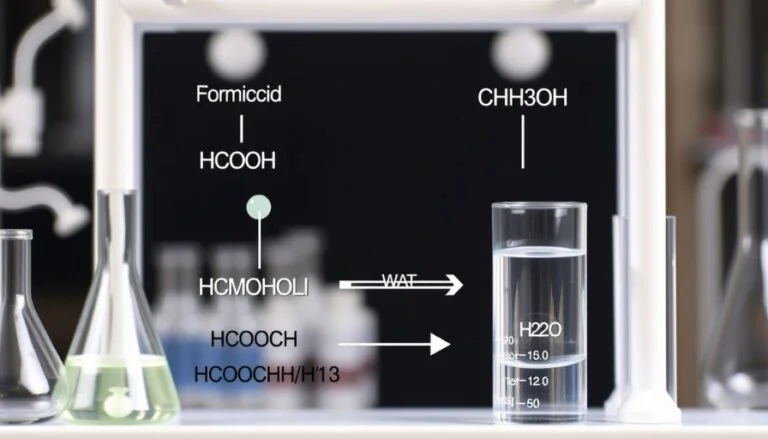
So, hcooch ch2 h2o isn’t a single molecule but seems to be a description of these parts together. It could be describing a chemical reaction, a mixture, or simply be a typo for a different compound.
Why Correct Chemical Formulas Matter
In science, precision is everything. A small change in a chemical formula can represent a completely different substance with unique properties. For example, H2O is water, but H2O2 is hydrogen peroxide, a powerful disinfectant. Using correct and standardized formulas prevents confusion and ensures safety and accuracy in scientific work. While we are exploring hcooch ch2 h2o for educational purposes, it’s a great reminder of why chemists have specific rules for writing formulas. This precision is not just for scientists; it’s crucial for industries from medicine to manufacturing. For more insights into scientific accuracy in various fields, you can find interesting articles at https://forbesplanet.co.uk/.
Exploring the Components: The Formate Group (HCOO)
The “HCOO” part of hcooch ch2 h2o points us toward formate esters. An ester is an organic compound made by reacting an acid with an alcohol. In this case, formate esters come from formic acid. Think of them as having a specific, often pleasant, smell. For example, methyl formate (HCOOCH3) and ethyl formate (HCOOC2H5) are two of the simplest formate esters. They are known for their fruity, rum-like aromas. Because of their scents, they are frequently used as artificial flavorings in food and as solvents in industrial applications. The formate group is the functional part of these molecules, meaning it’s where most chemical reactions happen. It’s a versatile and important structure in the world of organic chemistry.
Common Formate Esters
|
Ester Name |
Formula |
Common Use |
|---|---|---|
|
Methyl Formate |
HCOOCH3 |
Solvent, fumigant |
|
Ethyl Formate |
HCOOCH2CH3 |
Artificial rum/raspberry flavor |
|
Propyl Formate |
HCOOCH2CH2CH3 |
Solvent for resins |
The Role of the Methylene Group (CH2)
The “CH2” in hcooch ch2 h2o is the methylene group, a fundamental building block in organic chemistry. Imagine you’re building with LEGOs; the methylene group is like a basic 2×1 brick. It can connect to other atoms or groups of atoms, forming long chains or rings. This ability to form chains is called catenation, and it’s what makes carbon the backbone of all life on Earth. You can find methylene groups in countless molecules, from the plastics we use every day, like polyethylene, to the fats in our bodies. In the context of hcooch ch2 h2o, the CH2 group could be acting as a bridge, perhaps connecting the formate group to another part of a larger, hypothetical molecule. Its presence signifies a carbon-based, or organic, structure.
Water’s Role in Chemistry (H2O)
Water (H2O) is more than just a drink; it’s a universal solvent and a key player in countless chemical reactions. The inclusion of “H2O” in the term hcooch ch2 h2o strongly suggests its involvement. In chemistry, water can facilitate reactions, act as a product, or be a reactant itself. One of the most important reactions involving water is hydrolysis. Hydrolysis means “to break with water.” In this process, a water molecule splits a larger molecule into two smaller parts. This is highly relevant when we consider esters. If we have a formate ester, adding water (often with a little help from an acid or a base) can break it back down into formic acid and an alcohol. This reaction is fundamental in both industrial processes and biological systems, like digestion.
What is Hydrolysis?
Hydrolysis is a chemical reaction where water is used to break down the bonds of a particular substance. Think of it like a key (water) that unlocks a complex molecule, splitting it into simpler pieces.
- The Reactants: A large compound and water.
- The Process: The water molecule (H-OH) splits. The H attaches to one part of the large compound, and the OH attaches to the other.
- The Products: Two or more smaller, simpler molecules.
In the case of an ester like ethyl formate, hydrolysis would look like this:
HCOOCH2CH3 (Ethyl Formate) + H2O (Water) → HCOOH (Formic Acid) + CH3CH2OH (Ethanol)
This process is reversible and is a cornerstone of organic chemistry. The presence of “H2O” in hcooch ch2 h2o makes hydrolysis a very likely context for this term.
Putting It All Together: A Possible Reaction
So, what could hcooch ch2 h2o actually mean in a chemical context? One strong possibility is that it describes the hydrolysis of a hypothetical formate ester. Let’s imagine a molecule where a formate group is attached to a methylene group, which is then attached to something else (let’s call it “R”). The formula could look like HCOOCH2-R. If this substance reacts with water (H2O), it would undergo hydrolysis. The water would break the ester bond, resulting in formic acid (HCOOH) and an alcohol (HO-CH2-R). This scenario neatly combines all three components of the term hcooch ch2 h2o into a single, logical chemical process. It highlights how these individual parts interact to cause a chemical transformation.
Why is Understanding These Concepts Important?
You might be thinking, “This is interesting, but why does it matter to me?” Understanding basic chemical components like those in hcooch ch2 h2o is like learning the alphabet of the material world. These concepts are not just confined to a lab.
- In Biology: Hydrolysis is how your body digests food. Enzymes in your digestive system use water to break down complex carbohydrates, proteins, and fats into smaller molecules your body can absorb.
- In Industry: Esters are used to create everything from perfumes and food flavorings to plastics and biodiesel. Controlling their creation and breakdown is crucial for manufacturing.
- In the Environment: These chemical principles help us understand how pollutants break down in water and how nutrients are cycled through ecosystems.
By decoding a term like hcooch ch2 h2o, you build a foundation for understanding the world on a molecular level.
Conclusion
While the term hcooch ch2 h2o is not a standard chemical name, it serves as a fantastic educational tool. By breaking it down, we’ve journeyed through key concepts in organic chemistry, from the fragrant world of formate esters to the fundamental role of the methylene group and the power of water in hydrolysis reactions. We’ve seen that this seemingly confusing term can be interpreted as a description of a chemical reaction, likely the hydrolysis of a formate ester. This exploration reminds us that even confusing terms can be understood by examining their parts. It demonstrates the logical and block-like nature of chemistry and reinforces the importance of precise scientific language. Hopefully, you now feel more confident in tackling strange chemical terms and have a deeper appreciation for the building blocks that make up our world.
Frequently Asked Questions (FAQ)
Is hcooch ch2 h2o a real chemical compound?
No, hcooch ch2 h2o is not a recognized chemical compound with a standard formula or name. It appears to be a combination of different chemical groups (formate, methylene) and a molecule (water), likely describing a mixture or a reaction.
What does the “HCOO” part mean?
The “HCOO” part represents the formate group, which is derived from formic acid. It is the functional group in formate esters, which are often used for their pleasant scents in perfumes and artificial flavorings.
What is the significance of the “CH2” group?
“CH2” is a methylene group, a basic building block in organic chemistry. It consists of one carbon atom and two hydrogen atoms and acts as a linker to form the carbon chains and skeletons of most organic molecules.
Why is “H2O” included in the term?
The inclusion of “H2O” (water) strongly suggests a chemical reaction involving water, most likely hydrolysis. Hydrolysis is a process where water is used to break down a larger molecule into smaller parts, which is a common reaction for esters.
Could hcooch ch2 h2o be a typo?
Yes, it is very possible. It could be a typo for a specific formate ester like methyl formate (HCOOCH3) or an attempt to describe a reaction involving such a compound with water. Scientific communication relies on accuracy, so typos can create significant confusion.
Related Posts



Stay Informed With the Latest & Most Important News
Previous Post
Next Post









Advertisement