
Now Reading: The Ultimate Guide to the Champions League: Soccer’s Biggest Stage
-
01
The Ultimate Guide to the Champions League: Soccer’s Biggest Stage

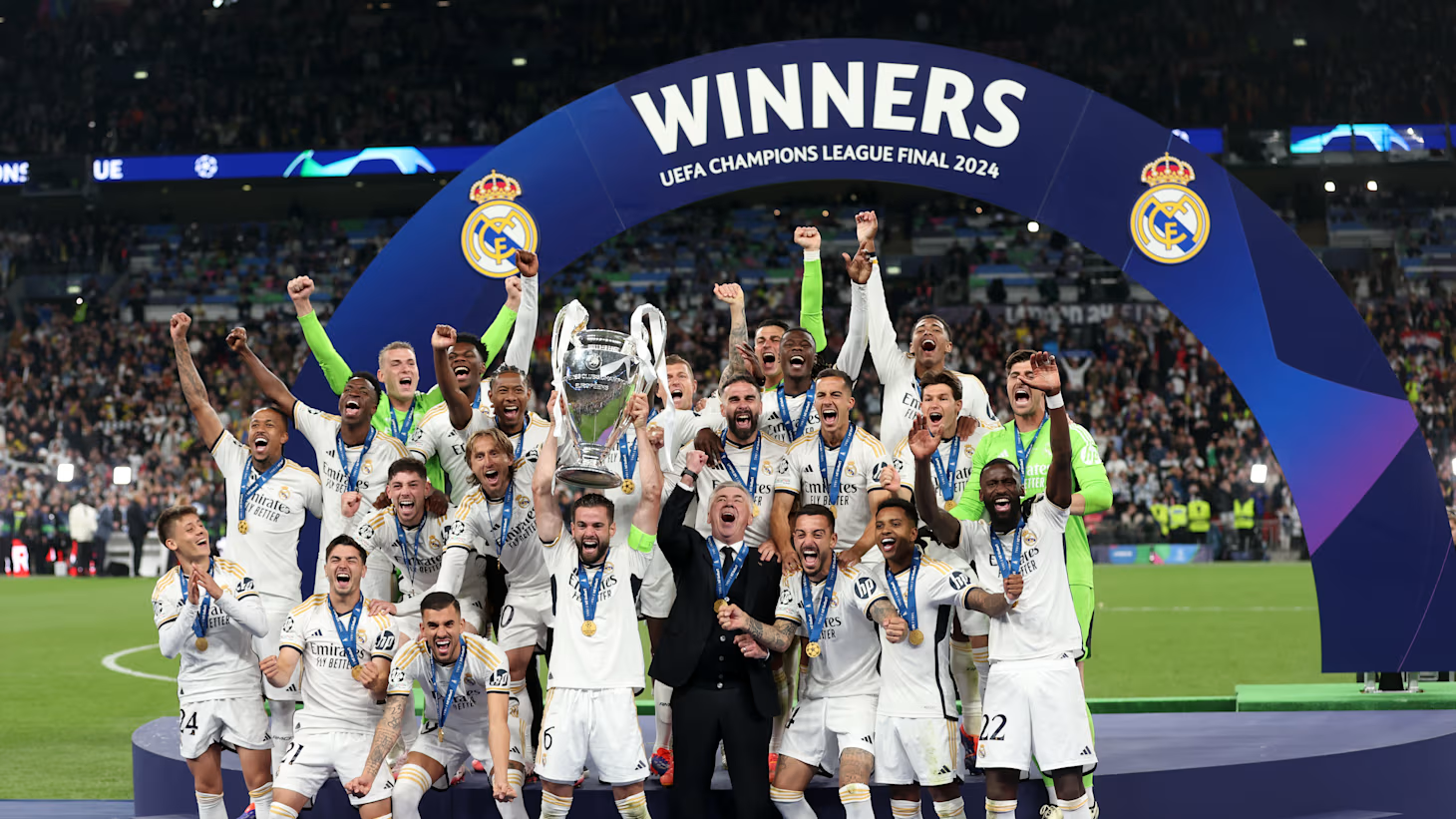
The music starts, the players line up, and fans around the world hold their breath. It is time for the Champions League. For many soccer fans, especially here in the United States where the sport is growing faster than ever, this tournament represents the absolute peak of club competition. It isn’t just a series of games; it is a season-long drama filled with last-minute goals, heartbreaking defeats, and moments of pure magic.
Whether you are a die-hard supporter waking up early to catch a mid-week match or a new fan trying to understand what all the hype is about, this guide is for you. We are going to dive deep into what makes this tournament special, how it works, and why it captures the hearts of millions. From the iconic anthem to the big-eared trophy, we will cover it all.
Key Takeaways
- Best of the Best: The Champions League features the top soccer clubs from across Europe competing for the most prestigious trophy in club football.
- Global Spectacle: It attracts massive viewership worldwide, including a rapidly growing audience in the United States.
- Star Power: This is where the world’s best players, like Messi, Ronaldo, Haaland, and Mbappé, shine brightest.
- Evolution: The tournament has evolved from the old European Cup into the modern, high-stakes format we see today.
What is the Champions League?
At its core, the Champions League is an annual continental club football competition organized by the Union of European Football Associations (UEFA). Think of it as the Super Bowl, but instead of one game at the end of the season involving just one country, it is a tournament that runs throughout the year involving the best teams from many different countries like England, Spain, Germany, and Italy.
Top-division European clubs compete based on their performance in their national leagues and cup competitions. If a team wins the English Premier League, for example, they automatically qualify. It is the most watched annual sporting event worldwide. The final alone draws hundreds of millions of viewers, often surpassing major American sporting events in global reach. For a player, winning this trophy is often considered the pinnacle of their club career.
A Brief History of the Tournament
The competition wasn’t always the glitzy, high-production event we see today. It started in 1955 as the European Champion Clubs’ Cup, generally known as the European Cup. Back then, it was a straight knockout tournament open only to the champion club of each country. If you lost, you went home immediately. There were no group stages to save you from a bad day at the office.
In 1992, the competition underwent a massive rebranding and became the UEFA Champions League. This change introduced a round-robin group stage and allowed multiple entrants from certain countries. This was a game-changer because it meant more big games between big teams. Instead of just champions, the runners-up and third or fourth-place teams from strong leagues could also join the party.
Why It Matters So Much
You might wonder why a tournament in Europe matters to fans in the US or Asia. The answer lies in the quality. Because the wealthiest and most historically significant clubs are in Europe, the best players from South America, Africa, Asia, and North America flock there to play. The Champions League is essentially an “All-Star” tournament that happens every year, but with real teams that have chemistry and history.
Winning your domestic league is huge, but conquering Europe proves you are the best of the best. It brings massive financial rewards to the clubs, global prestige, and bragging rights that last a lifetime. For fans, the mid-week fixtures (usually Tuesdays and Wednesdays) become ritualistic viewing events.
Understanding the Format
The format of the Champions League can be a little confusing for newcomers, especially with recent changes. Historically, the most famous format involved a “Group Stage” followed by “Knockout Rounds.” In the traditional format, 32 teams were split into eight groups of four. They played each other twice—once at home and once away. The top two teams advanced to the Round of 16.
However, soccer never stands still. UEFA has introduced a new “League Phase” format starting in the 2024/25 season. This change is designed to create even more excitement and ensure that top teams play each other earlier in the competition. It moves away from the traditional group stage to a single league table including all participating teams.
The New “Swiss Model” Explained
Under the new format, the number of teams increases from 32 to 36. Instead of being divided into small groups, all 36 clubs are ranked in a single league table. This is often referred to as the “Swiss Model.” But don’t worry, they don’t play everyone!
- Number of Matches: Each team plays eight matches in this new phase.
- Opponents: They play eight different opponents (four home games and four away games).
- Qualification: The top eight teams in the league qualify automatically for the Round of 16. Teams finishing 9th to 24th enter a two-legged playoff to secure their spot in the next round.
This ensures that every game matters. In the old system, the last few group games were sometimes meaningless if a team had already qualified. Now, fighting for a higher position in the table is crucial to avoid extra playoff games.
The Knockout Stages
Once the initial phase is done, we enter the drama of the knockout stages. This remains largely the same as before. It consists of the Round of 16, Quarter-finals, and Semi-finals. In these rounds, teams play each other twice (home and away). The team with the higher aggregate score (total goals over two games) moves on.
If the score is tied after the second game, they play extra time (two periods of 15 minutes). If they are still tied, the game goes to a penalty shootout. This is often where heroes are made and hearts are broken. The tension during a Champions League penalty shootout is unlike anything else in sports.
The Grand Final
The final is a single match played at a neutral venue chosen years in advance. It is a massive spectacle, complete with opening ceremonies and huge fanfare. The winner is crowned the King of Europe and lifts the iconic trophy, affectionately known as “Old Big Ears” because of the large handles on the side.
|
Stage |
Format |
Key Feature |
|---|---|---|
|
League Phase |
36 Teams, Single Table |
8 games per team against different opponents. |
|
Playoff Round |
2-legged knockout |
Teams ranked 9th-24th fight for survival. |
|
Round of 16 |
2-legged knockout |
The top 8 join the playoff winners. |
|
Quarter-finals |
2-legged knockout |
The final 8 teams battle. |
|
Final |
Single Match |
Winner takes all at a neutral venue. |
The Teams That Define the Era
When we talk about the Champions League, certain names immediately spring to mind. These clubs have built dynasties and defined eras of football history. Their jerseys are seen in parks and stadiums all across the United States.
Real Madrid: The Kings of Europe
No conversation about this tournament is complete without mentioning Real Madrid. The Spanish giants have won the competition more times than any other club—by a significant margin. They have a special relationship with the European Cup. It seems that no matter how they are performing in their domestic league, when the Champions League anthem plays, they transform into an unstoppable force.
Their strategy has often involved signing “Galácticos”—the biggest stars in the world—to ensure success. From Di Stéfano in the 50s to Zidane in the 2000s and Ronaldo in the 2010s, Real Madrid is synonymous with European glory.
English Premier League Dominance
Clubs from England have had massive success as well. Liverpool, Manchester United, and Chelsea have all lifted the trophy multiple times. More recently, Manchester City has joined the elite list of winners. The intense competition in the Premier League often prepares these teams well for the physical and fast-paced nature of European nights.
American fans often gravitate toward these teams because the Premier League is easily accessible on US television. The atmosphere at stadiums like Anfield (Liverpool) on a European night is legendary, known for intimidating even the best opponents.
Other European Giants
- AC Milan (Italy): Historically the second most successful team in the competition, known for their tactical discipline and legendary defenders.
- Bayern Munich (Germany): A powerhouse of efficiency and attacking football. They are perennial contenders and rarely miss the later stages of the tournament.
- FC Barcelona (Spain): Famous for their “tiki-taka” style of play that mesmerized the world, particularly during the era of Lionel Messi.
The Players Who Shine
The Champions League is the ultimate stage for individual brilliance. While soccer is a team sport, this tournament is where the “Greatest of All Time” debates are often settled. Players know that to be considered a true legend, they need to perform here.
Cristiano Ronaldo vs. Lionel Messi
For over a decade, the tournament was the personal playground of Cristiano Ronaldo and Lionel Messi. They shattered almost every record imaginable. Ronaldo holds the record for the most goals in the history of the competition. His athleticism and drive to win made him a nightmare for defenders across Europe.
Messi, on the other hand, brought magic. His dribbling, vision, and goal-scoring ability for Barcelona created moments of pure art. Their rivalry pushed both of them to heights that may never be reached again. Even though they have moved on from European football, their legacy in the Champions League remains untouched.
The New Generation
As the old guard steps back, a new generation is taking over. Erling Haaland (Manchester City) and Kylian Mbappé (Real Madrid) are the new faces of the competition. Haaland is a goal-scoring machine, breaking records for speed and efficiency. Mbappé possesses blistering pace and skill that terrifies defenses.
Fans in the US are also keeping a close eye on American stars playing in the competition. Players like Christian Pulisic, who won the trophy with Chelsea, have shown that US talent can compete and succeed at the very highest level.
The Economic Impact
The Champions League is big business. The revenue generated by the tournament is astronomical. This money comes from broadcasting rights, sponsorships, and ticket sales. UEFA distributes a large portion of this revenue back to the participating clubs.
For a smaller club, just qualifying for the group stage/league phase can be transformative. The prize money can fund stadium upgrades, better training facilities, and new player signings. This is why the race to finish in the “Top 4” of domestic leagues (which usually grants qualification) is often more intense than the race for the title itself.
Broadcasting and Viewership
In the United States, networks fight hard for the rights to broadcast these games. The viewership numbers have been climbing steadily. Networks like CBS and Paramount+ have invested heavily in their coverage, bringing a mix of expert analysis and entertainment that appeals to American audiences.
The “Golazo Show,” which whips around to every game as goals happen, has become a favorite way for fans to consume the action, catering to the shorter attention spans and the desire to see every big moment live.
Sponsorships
Major global brands line up to be associated with the tournament. You will recognize the iconic sponsors on the advertising boards surrounding the pitch. This commercial success allows the tournament to maintain its high production value and global reach. If you are looking for more insights on business and wealth related to sports, you might find interesting articles on https://forbesplanet.co.uk/, which covers various topics on luxury and finance.
Why the Anthem is Iconic
Even if you aren’t a soccer expert, you might recognize the anthem. Written by Tony Britten in 1992, it is an adaptation of Handel’s “Zadok the Priest.” The lyrics are simple, sung in three languages (English, German, and French): “Die Meister! Die Besten! Les grandes équipes! The champions!”
When that music hits before kickoff, it sends shivers down spines. Players often sing along, and the camera pans across their focused faces. It signals that this is not just a game; it is an event. It sets the tone for the high drama that is about to unfold.
Challenges and Controversies
No major sporting event is without its issues. The Champions League faces challenges regarding financial disparity. The richest clubs tend to get richer, making it harder for smaller teams to compete. This has led to discussions about a “European Super League,” a closed shop for elite clubs, though fan backlash has largely kept these ideas at bay so far.
Refereeing decisions, particularly with the introduction of VAR (Video Assistant Referee), are also a constant source of debate. A tight offside call or a controversial penalty can decide a team’s fate and cost them millions of dollars.
Financial Fair Play (FFP)
To try and keep things fair, UEFA introduced Financial Fair Play regulations. These rules are designed to stop clubs from spending more than they earn. The goal is to prevent rich owners from simply buying success and to ensure the long-term sustainability of football clubs. However, the effectiveness and enforcement of these rules are often debated by fans and experts alike.
Tips for US Fans
Following the Champions League from the United States requires a bit of dedication due to the time difference. Matches usually kick off mid-afternoon on weekdays (around 3:00 PM ET).
- Avoid Spoilers: If you are at work or school, turn off notifications so you can watch the replay later.
- Find a Local Pub: Many cities have soccer bars that show the games. The atmosphere there can be electric.
- Streaming Services: Ensure you have a subscription to the service holding the rights (currently Paramount+ and CBS Sports).
- Follow Social Media: The memes and highlights on Twitter and Instagram are half the fun of the modern fan experience.
Frequently Asked Questions (FAQ)
Here are some common questions people have about the tournament.
Q: Who qualifies for the Champions League?
A: Teams qualify based on their final position in their domestic league from the previous season. The stronger the league (like England or Spain), the more teams they get to send (usually top 4).
Q: Has a US team ever played in the Champions League?
A: No, this is a European competition. Only clubs from Europe can participate. However, US players who play for European clubs do participate.
Q: Who has won the most titles?
A: Real Madrid holds the record for the most titles won.
Q: Is the winner of the Champions League the best team in the world?
A: Generally, yes. They go on to play in the FIFA Club World Cup, where they usually win against champions from other continents, reinforcing the idea that Europe has the strongest clubs.
Q: Why are the games played on Tuesdays and Wednesdays?
A: Matches are played mid-week to avoid clashing with domestic league games, which usually take place on weekends.
Conclusion
The Champions League is a celebration of soccer excellence. It brings together diverse cultures, styles, and passions into one spectacular tournament. For the players, it is the pursuit of immortality. For the fans, it is a rollercoaster of emotions that creates memories lasting a lifetime.
As the tournament evolves with new formats and new stars, the core magic remains the same. It is the best against the best, under the floodlights, with the world watching. Whether you are rooting for an underdog story or cheering on a juggernaut, the competition delivers drama like no other.
From the first whistle of the qualifiers to the trophy lift in May, the journey is captivating. If you are looking to get into soccer, there is no better starting point than watching a big European night. So, grab your jersey, learn the anthem, and get ready for the beautiful game at its absolute finest. For more detailed history and records, you can check out this resource from Wikipedia regarding the Champions League.
Stay Informed With the Latest & Most Important News
Previous Post
Next Post










Advertisement