

Now Reading: How CAD Conversion Supports BIM and Digital Construction Workflows
-
01
How CAD Conversion Supports BIM and Digital Construction Workflows

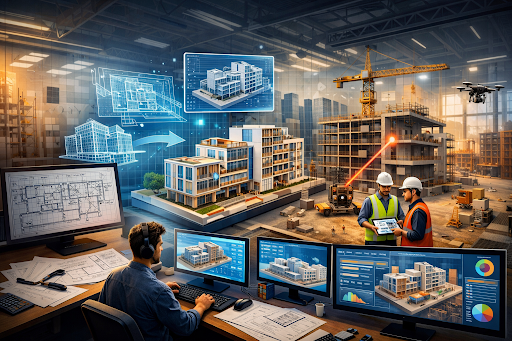
Why Is CAD Conversion Becoming the Backbone of Modern Construction?
The global construction industry is undergoing a profound digital transformation. Across the USA, UK, and other developed markets, firms are shifting away from traditional drawing-based processes toward intelligent, data-driven workflows. At the heart of this evolution lies CAD conversion, a foundational process that bridges legacy drawings with modern BIM and digital construction ecosystems.
From architects and engineers to contractors and real estate developers, professionals increasingly rely on cad conversion services in USA and the UK to transform static 2D drawings into dynamic, data-rich 3D models. These conversions are not merely technical upgrades; they are strategic enablers for efficiency, collaboration, compliance, and long-term asset management.
As BIM adoption accelerates and digital twins become mainstream, understanding how CAD conversion supports BIM and digital construction workflows is no longer optional, it’s essential.
What Is CAD Conversion in the Context of BIM and Digital Construction?
CAD conversion refers to the process of transforming existing drawings paper-based, scanned files, or outdated CAD formats into modern, standardized digital models. In BIM-driven projects, this often includes:
- 2D to 3D CAD conversion
- CAD to BIM conversion services
- Standardizing layers, units, and object data
- Embedding metadata for construction and facility management
In practical terms, CAD conversion helps project teams convert 2D drawing to 3D model, making designs usable within BIM platforms such as Revit, Archicad, or Navisworks.
According to a report by McKinsey, digital construction methods including BIM can reduce project costs by up to 20% and accelerate delivery by 10–15%. (Source: https://www.mckinsey.com/industries/capital-projects-and-infrastructure/our-insights)
Without accurate CAD conversion, these gains are difficult to achieve.
Why Do BIM Workflows Depend on High-Quality CAD Conversion?
BIM Is Only as Accurate as Its Input Data
BIM models are data-driven environments. Every wall, slab, door, or MEP component contains information related to:
- Dimensions
- Materials
- Costs
- Performance
- Lifecycle maintenance
When legacy CAD drawings are poorly converted, BIM workflows suffer from:
- Data inconsistencies
- Misaligned geometries
- Rework during construction
- Cost overruns
This is why cad to bim conversion services play a critical role in ensuring BIM-ready data accuracy from the start.
How Does CAD Conversion Enable Digital Construction Workflows?
Digital construction goes beyond 3D modeling. It integrates design, planning, construction, and operations into a unified digital ecosystem. CAD conversion acts as the gateway into this ecosystem.
Key Ways CAD Conversion Supports Digital Construction:
- Converts static drawings into intelligent, interoperable models
- Enables clash detection and constructability analysis
- Supports 4D (time) and 5D (cost) BIM simulations
- Enhances coordination between global teams
According to Autodesk, BIM-based workflows reduce design coordination errors by up to 61%.
These benefits begin with accurate CAD-to-BIM conversion.
What Role Does 2D to 3D Conversion Play in Modern Projects?
Why Are Firms Moving Beyond 2D Drawings?
While 2D drawings remain useful for documentation, they lack the spatial clarity required for complex projects. This is especially true in infrastructure, healthcare, commercial, and mixed-use developments across the USA and UK.
By choosing to convert 2d floor plan to 3d autocad, teams gain:
- Better visualization for stakeholders
- Improved design validation
- Faster approval cycles
- Reduced site errors
Benefits of Converting 2D Drawings to 3D Models:
- Clear representation of design intent
- Early identification of clashes
- Seamless integration with BIM platforms
- Enhanced client communication
A Dodge Data & Analytics study found that 75% of BIM users report positive ROI from improved visualization and coordination.
How Is CAD Conversion Supporting Compliance in the USA and UK?
Why Is Compliance a Growing Concern?
Building regulations in the USA and UK are becoming increasingly complex. From IBC standards in the US to UK Building Regulations and BS standards, compliance now requires precision and traceability.
CAD conversion supports compliance by:
- Standardizing drawings to regional codes
- Enabling rule-based BIM validation
- Supporting sustainability and energy modeling
Converted BIM-ready CAD files allow teams to simulate performance and ensure regulatory alignment early in the design phase, reducing costly revisions later.
What Are the Latest Trends in CAD Conversion and BIM Integration?
1. AI-Assisted CAD Conversion
Artificial intelligence is now being used to automate repetitive CAD conversion tasks, improving speed and consistency.
2. Cloud-Based Collaboration
Converted CAD and BIM models are increasingly hosted on cloud platforms, enabling real-time collaboration across global teams.
3. Digital Twins
Accurate CAD-to-BIM conversion is foundational for creating digital twins used in asset management and smart cities.
4. Scan-to-BIM Integration
Laser scans combined with CAD conversion are helping retrofit and renovation projects achieve millimeter-level accuracy.
According to MarketsandMarkets, the global BIM market is projected to reach USD 15.7 billion by 2027, driven by digital construction adoption.
What Challenges Do Firms Face Without Proper CAD Conversion?
Despite its importance, many organizations still underestimate CAD conversion.
Common Challenges Include:
- Inconsistent legacy drawings
- Missing dimensions or annotations
- Non-standard CAD layers
- Lack of BIM compatibility
These issues can lead to:
- Project delays
- Design conflicts
- Increased RFIs
- Budget overruns
This is why businesses increasingly rely on specialized cad conversion services in usa and the UK to mitigate risks and ensure accuracy.
How Does CAD Conversion Improve Collaboration Across Stakeholders?
Why Collaboration Matters More Than Ever
Modern construction projects involve architects, engineers, contractors, consultants, and owners often spread across different regions.
CAD conversion supports collaboration by:
- Creating a single source of truth
- Enabling multidisciplinary coordination
- Reducing misinterpretation of drawings
When teams convert 2d drawing to 3d model, communication improves dramatically, especially during design reviews and coordination meetings.
What Opportunities Does CAD Conversion Create for Businesses and Startups?
For startups and growing firms in AEC and real estate, CAD conversion offers strategic advantages:
- Faster project onboarding
- Scalability without expanding in-house teams
- Access to global BIM workflows
- Competitive differentiation
With governments in the USA and UK increasingly mandating BIM for public projects, CAD conversion is no longer just a technical service, it’s a business enabler.
Why Is CAD Conversion Critical for the Future of Digital Construction?
As the industry moves toward automation, sustainability, and lifecycle-driven design, accurate digital foundations are essential.
CAD conversion ensures:
- Legacy data remains usable
- BIM investments deliver ROI
- Digital construction workflows remain scalable
Simply put, BIM cannot function effectively without high-quality converted data.
Final Thoughts:
CAD conversion is not a one-time technical task, it is a strategic process that supports the entire lifecycle of digital construction projects. From early design visualization to BIM coordination, compliance, and digital twins, its impact is far-reaching.
As AEC firms in the USA, UK, and globally continue to embrace BIM and digital construction, investing in reliable CAD conversion will remain a critical success factor. Many organizations now partner with experienced UK-based CAD design companies that specialize in accurate, standards-compliant conversions to support global BIM workflows ensuring their projects are future-ready, efficient, and digitally resilient.
FAQs
1: What is CAD conversion and why is it important for BIM projects?
Answer:
CAD conversion is the process of transforming legacy 2D drawings or outdated CAD files into modern digital formats that are compatible with BIM software. It is essential for BIM projects because accurate converted data ensures reliable 3D modeling, clash detection, cost estimation, and lifecycle management. Without proper CAD conversion, BIM workflows can suffer from errors, rework, and data inconsistencies especially in large-scale projects across the USA and UK.
2: How do CAD conversion services in USA support digital construction workflows?
Answer:
CAD conversion services in USA support digital construction by enabling seamless integration of old drawings into BIM platforms. These services help standardize design data, improve collaboration among stakeholders, and support 4D and 5D BIM workflows. This allows construction teams to visualize schedules, manage costs, and reduce on-site conflicts before construction begins.
3: What is CAD to BIM conversion and how does it benefit AEC firms?
Answer:
CAD to BIM conversion services involve converting 2D CAD drawings into intelligent BIM models with embedded data. AEC firms benefit through improved coordination, reduced design errors, faster approvals, and better compliance with building regulations in the USA and UK. BIM-ready models also improve long-term asset and facility management.
4: Why should companies convert 2D drawings to 3D models for BIM?
Answer:
When companies convert 2D drawing to 3D model, they gain better visualization, improved design clarity, and early detection of clashes between architectural, structural, and MEP elements. This reduces construction risks, improves communication with stakeholders, and supports accurate quantity takeoffs and cost planning in BIM workflows.
5: How does converting 2D floor plans to 3D AutoCAD improve project accuracy?
Answer:
Converting 2D floor plan to 3D AutoCAD improves spatial accuracy by representing real-world dimensions and relationships between building elements. This helps architects and engineers validate designs, identify layout issues early, and ensure smooth transition into BIM platforms especially for commercial and residential projects in the USA and UK.
6: What challenges can occur without proper CAD conversion in BIM projects?
Answer:
Without proper CAD conversion, BIM projects may face issues such as inconsistent data, misaligned geometry, missing dimensions, and coordination conflicts. These challenges often result in increased RFIs, project delays, cost overruns, and compliance risks making accurate CAD conversion a critical step in digital construction workflows.
7: Is CAD conversion necessary for renovation and retrofit projects?
Answer:
Yes, CAD conversion is especially important for renovation and retrofit projects. Older buildings often lack accurate digital drawings. CAD conversion helps transform scanned or outdated plans into BIM-ready models, enabling precise planning, compliance checks, and integration with modern digital construction technologies such as digital twins.
Stay Informed With the Latest & Most Important News
Previous Post
Next Post











Advertisement