

Now Reading: The Ultimate Guide to Wimbledon: Tennis, Traditions, and History
-
01
The Ultimate Guide to Wimbledon: Tennis, Traditions, and History


Introduction
Imagine a place where the grass is cut to exactly 8 millimeters, everyone wears white, and the quiet is only broken by the sound of a tennis ball and polite applause. Welcome to Wimbledon, the most prestigious tennis tournament in the world. For two weeks every summer, fans across the globe turn their eyes to London to watch history unfold on the green lawns of the All England Club.
Whether you are a die-hard tennis player or just someone who enjoys watching sports highlights, this tournament offers something special. It is not just about forehands and backhands; it is a cultural event steeped in over a century of tradition. From the Royal Family watching from the Royal Box to the thousands of fans camping out in “The Queue,” the atmosphere is unlike any other sporting event.
In this guide, we will explore what makes this Grand Slam so unique. We will look at its history, the legends who have lifted the golden trophies, and the quirky rules that players must follow. By the end, you will understand exactly why Wimbledon is considered the pinnacle of the tennis world.
Key Takeaways
- Wimbledon is the oldest tennis tournament in the world, founded in 1877.
- It is the only Grand Slam event played on outdoor grass courts.
- Players must strictly adhere to an all-white dress code.
- The tournament is famous for traditions like strawberries and cream and the Royal Box.
- Roger Federer and Martina Navratilova hold records for the most singles titles.
What is Wimbledon? A General Overview
Wimbledon is one of the four Grand Slam tennis tournaments, which are the most important competitions in the sport. The other three are the Australian Open, the French Open, and the US Open. However, many people consider the London-based tournament to be the most important one of all. It takes place every year in late June and early July. The event is held at the All England Lawn Tennis and Croquet Club in a district of London famously known as Wimbledon.
What sets this tournament apart is that it is the only major played on grass. In the early days of tennis, most tournaments were played on grass, but over time, others switched to hard courts or clay because grass is difficult to maintain. By sticking to its roots, the tournament has preserved a classic style of tennis that rewards speed and precision.
For a tennis player, winning here is the ultimate dream. It is not just about the prize money, which is substantial; it is about writing your name in history. When a player wins, their name is engraved on a trophy alongside legends from the past 140 years. It is a legacy that lasts forever, making every match feel incredibly high-stakes and exciting for viewers.
The Rich History of Wimbledon
Origins in 1877
The story of Wimbledon began way back in 1877. The All England Croquet Club, as it was known then, was facing a financial problem. The popularity of croquet was fading, and a new sport called “Lawn Tennis” was becoming trendy. To raise money to repair a pony roller used to flatten the lawns, the club decided to hold a tennis tournament.
Only 22 men entered that first competition. The rules were slightly different from what we see today, and players used wooden rackets that looked very heavy compared to modern equipment. The final was watched by about 200 spectators who paid a shilling each to enter. Spencer Gore was the first champion, and he won 12 guineas in prize money. It was a humble beginning for an event that would eventually become a global phenomenon watched by millions.
Evolution Over the Decades
As the years went by, the tournament grew rapidly. In 1884, the club added Ladies’ Singles and Gentlemen’s Doubles competitions. This was a huge step forward, making the sport more inclusive. By the early 1900s, international players began to arrive, turning it into a truly global competition. The tournament paused during World War I and World War II, but it always bounced back stronger.
In 1968, the “Open Era” began. Before this, only amateur players could compete. Once professionals were allowed to join, the level of play skyrocketed. Television broadcasts brought the matches into living rooms around the world, turning players like Bjorn Borg and John McEnroe into superstars. Today, the event combines this deep history with modern technology, maintaining its classic feel while embracing the future.
Why Grass Courts Make Wimbledon Unique
The Speed of the Game
If you watch tennis on clay or hard courts, you might notice the ball bounces high and slow. On the grass courts of Wimbledon, the game is completely different. The ball skids off the grass, staying low and moving very fast. This changes how the players have to move and hit.
Because the ball moves so quickly, points are often shorter. Big serves are a massive advantage here. Players who can serve the ball fast and accurate are very hard to break. This surface favors aggressive players who like to come to the net and finish points quickly, rather than staying back and rallying for a long time. It makes for an exciting, fast-paced viewing experience where momentum can shift in a split second.
Maintenance of the Lawns
Maintaining the grass at the All England Club is almost a science. The grounds crew works year-round to ensure the courts are perfect for the two weeks of the tournament. The grass used is 100% perennial ryegrass, which is durable and grows well in the English climate.
During the tournament, the grass is cut to a precise height of 8mm every single morning. If it is too long, the ball slows down; if it is too short, the grass might die. The soil must be hard enough to let the ball bounce but soft enough to keep the grass healthy. It is a delicate balance. Even the amount of water used is carefully calculated based on the weather forecast. This dedication to perfection is a big part of why the tournament is so respected.
Iconic Traditions of the Tournament
The Strict All-White Dress Code
One of the most famous—and sometimes controversial—rules at Wimbledon is the dress code. Since the Victorian era, players have been required to wear “predominantly white” clothing. The original reason was that white shows fewer sweat stains, which was considered proper and polite in the 1800s.
Today, the rule is even stricter. Competitors must wear almost entirely white clothing, including their socks, shoes, and even the soles of their shoes. Small strips of color are allowed but can be no wider than one centimeter. Even huge stars like Roger Federer have been told to change their shoes if they had orange soles! While some players find it annoying, most agree that it looks elegant and keeps the focus on the tennis rather than fashion logos.
Strawberries and Cream
You cannot talk about this tournament without mentioning the food. The signature snack is strawberries and cream. Every year, fans consume over 28,000 kilograms of strawberries and 7,000 liters of cream. The berries are picked early in the morning in Kent and delivered fresh to the grounds.
This tradition dates back to the very first tournament in 1877. Strawberries were in season during the short British summer, making them the perfect treat. It has become such a staple that even people watching at home will buy a punnet of strawberries to feel like they are part of the action. It is a simple, delicious tradition that connects modern fans to the Victorian origins of the event.
The Royal Box
The Royal Box is located at the south end of Centre Court. It has 74 seats reserved for members of the British Royal Family and invited guests. These guests often include heads of government, people from the world of tennis, commercial partners, British armed forces, and prominent media organizations.
Seeing who is sitting in the Royal Box is a fun side activity for fans. You might spot the Prince and Princess of Wales, famous actors, or legendary athletes. In the past, players were required to bow or curtsy to the Royal Box when entering or leaving the court. That rule was discontinued in 2003, though players still bow if the King or Queen is present. It adds a touch of regal elegance that you do not see at the US Open or Australian Open.
The Wimbledon Venue: The All England Club
Centre Court and the Roof
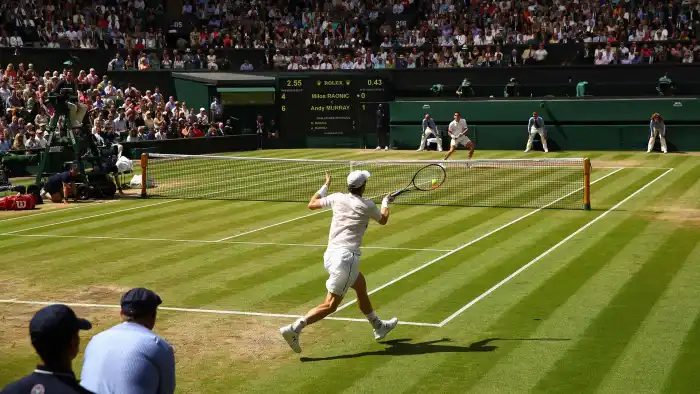
Centre Court is the main stage. It is where the finals are played and where the biggest stars compete. It holds nearly 15,000 people. For over 80 years, the court was open to the sky, which meant rain often caused long delays. In England, rain is very common, and matches would sometimes be pushed back by days.
In 2009, a retractable roof was installed on Centre Court. This was a massive engineering feat. The roof takes about 10 minutes to close, allowing play to continue even during a storm. It also has lights, so matches can go on into the evening. This changed the tournament forever, ensuring that the TV audience and ticket holders are guaranteed to see tennis, rain or shine.
No. 1 Court and the Grounds
While Centre Court gets the most glory, No. 1 Court is also spectacular. It is the second-biggest stadium at the venue and also received a retractable roof recently, in 2019. The atmosphere here can be just as electric as Centre Court, often hosting crucial quarter-finals or upsets.
Beyond the big stadiums, there are 16 other courts where matches happen. In the first week of the tournament, the “outside courts” are buzzing with activity. Fans can walk around and stand just a few feet away from world-class players. The grounds are beautifully landscaped with purple and green flowers—the official colors of the club. It feels like a garden party that happens to host a tennis tournament.
Famous Champions and Legends
The Federer, Nadal, Djokovic Era
In recent history, the Men’s Singles has been dominated by three names: Roger Federer, Rafael Nadal, and Novak Djokovic. Roger Federer is often called the “King of Grass.” He won eight titles here, a record for men. His style was elegant and smooth, perfect for the grass surface.
Novak Djokovic has also been incredible, winning multiple titles and showing amazing mental strength. Rafael Nadal, known for his prowess on clay, adapted his game to win two famous titles on the London grass. The rivalry between these three has provided some of the greatest matches in sports history, specifically the 2008 final between Nadal and Federer, which many call the greatest match ever played.
The Williams Sisters’ Dominance
On the women’s side, Venus and Serena Williams changed the game forever. They brought power and athleticism that had never been seen before. Between the two of them, they have won the singles title 12 times. There were years where they would meet each other in the final, which was an incredible achievement for one family.
Serena Williams is considered one of the greatest athletes of all time. Her serve was a major weapon on the fast grass courts. Venus Williams also thrived here, winning five titles. Their success inspired a whole new generation of young girls, particularly in the United States, to pick up a racket and dream of playing on Centre Court.
Historical Greats
Before the modern era, there were other giants of the game. Martina Navratilova is arguably the greatest grass-court player ever. She won an astonishing nine Ladies’ Singles titles, a record that still stands today. Her aggressive serve-and-volley style was unbeatable in the 1980s.
Bjorn Borg, the cool Swede, won five titles in a row from 1976 to 1980. His rivalry with the fiery American John McEnroe is the stuff of legend. Pete Sampras was another master of the grass, winning seven titles in eight years during the 1990s. These legends built the prestige that today’s players are chasing.
Most Singles Titles at Wimbledon (Open Era)
|
Player |
Country |
Titles |
|---|---|---|
|
Martina Navratilova |
USA |
9 |
|
Roger Federer |
Switzerland |
8 |
|
Steffi Graf |
Germany |
7 |
|
Serena Williams |
USA |
7 |
|
Novak Djokovic |
Serbia |
7 |
|
Pete Sampras |
USA |
7 |
|
Venus Williams |
USA |
5 |
|
Bjorn Borg |
Sweden |
5 |
How the Tournament Works
The Draw and Seeding
The tournament starts with 128 men and 128 women in the singles draws. The top players are “seeded” based on their world rankings. There are usually 32 seeds. The purpose of seeding is to ensure the best players do not meet each other in the very first round.
The draw is done randomly for the unseeded players. Being unseeded is dangerous because you might have to play the number one player in the world on the very first day! The path to the trophy requires winning seven matches in a row over two weeks. One bad day, and you are out—there are no second chances in a knockout tournament.
The Scoring System
Tennis scoring can be confusing for beginners. Points go: 15, 30, 40, and then Game. If both players get to 40, it is called “Deuce.” From Deuce, a player must win two consecutive points to win the game.
To win a “Set,” a player usually needs to win six games, and be ahead by at least two games. In the men’s Grand Slams, you have to win three sets to win the match (Best of 5). In women’s Grand Slams, you need to win two sets (Best of 3). This makes the men’s matches much longer; they can sometimes last five hours or more!
Tie-Breaks and Final Sets
For a long time, Wimbledon did not have a tie-break in the final set. Players just kept playing until someone was two games ahead. This led to the longest match in history in 2010, where John Isner beat Nicolas Mahut 70-68 in the final set. The match took three days to finish!
To prevent this from happening again and exhausting the players, the rules were changed. Now, if the score reaches 6-6 in the final set (the 5th set for men, 3rd for women), they play a “super tie-break.” The first person to get to 10 points (leading by 2) wins the match. This keeps the drama but ensures the match finishes in a reasonable time.
The Experience for Fans
The Queue
Unlike many other major sporting events where tickets sell out months in advance online, Wimbledon reserves tickets for sale on the day of play. This has created a tradition known as “The Queue.” Fans arrive with tents and sleeping bags, camping out in a nearby park overnight just to get a ticket.
The Queue is incredibly organized and polite. You get a queue card with your number on it when you arrive. Stewards wake everyone up early in the morning, and the line moves slowly toward the gates. It is a social event where people make friends, play frisbee, and share food while waiting. For many, the camping is just as fun as the tennis itself.
Henman Hill (or Murray Mound)
If you cannot get a ticket for the show courts, you can buy a “Grounds Pass.” This lets you roam the outside courts, but you can also sit on a large grassy hill called Aorangi Terrace. A giant TV screen shows the big matches happening on Centre Court.
This hill is affectionately nicknamed after British tennis heroes. In the 1990s and early 2000s, it was called “Henman Hill” after Tim Henman. Later, it became known as “Murray Mound” when Andy Murray started winning. Thousands of fans pack onto the hill, cheering and waving flags. The atmosphere here is often louder and more energetic than inside the stadium!
If you are planning a trip to London to experience this atmosphere, or perhaps looking for luxury travel tips for the UK, check out https://forbesplanet.co.uk/ for excellent guides on lifestyle and travel.
Prize Money and Trophies
The Gentlemen’s Singles Trophy
The winner of the Men’s Singles receives a stunning silver-gilt cup. It is about 18 inches high and has been used since 1887. The trophy has a pineapple on top of it. Why a pineapple? No one is 100% sure, but back in the 17th century, pineapples were a rare symbol of significant wealth and hospitality, so it was likely a design choice to show prestige.
The winner does not get to keep the actual trophy. They get to hold it for photos and walk around the court with it. Afterward, they receive a smaller replica to take home, while the original stays safely at the museum in the club.
The Rosewater Dish
The Ladies’ Singles champion wins the “Venus Rosewater Dish.” It is a large silver salver (a flat tray) decorated with figures from mythology. It was made in 1864, which is actually older than the tournament itself!
Like the men, the women receive a replica to keep. Both champions also get their names engraved on the club’s honor boards. Walking through the clubhouse and seeing your name on the wall is often described by players as the proudest moment of their careers.
Prize Money Growth (Approximate)
The prize money has grown massively over the years.
- 1968: Winner received approx £2,000
- 1990: Winner received approx £230,000
- 2010: Winner received approx £1,000,000
- 2023: Winner received approx £2,350,000
Wimbledon in Pop Culture
The tournament has crossed over into movies and fashion. The most famous movie is arguably the 2004 film Wimbledon, starring Kirsten Dunst and Paul Bettany. It captured the romance and tension of the tournament, even if some of the tennis scenes were a bit Hollywood-ized.
Fashion-wise, the “tennis aesthetic” often trends during the summer. Brands release special white collections in June. The preppy look of polo shirts, pleated skirts, and sweaters tied around the shoulders becomes popular on streets from New York to Tokyo. The tournament represents a clean, classic style that influences how people dress well beyond the tennis courts.
Challenges and Future of the Tournament
Weather Delays
Despite the new roofs, weather is still the biggest challenge. Rain can disrupt the schedule on the outside courts, causing a backlog of matches. This is tough for players who might have to play every day without a rest to catch up.
The organizers are always looking for ways to improve this. There are plans to expand the grounds into a neighboring golf course, which would allow for more courts and potentially another stadium with a roof. This expansion is controversial among some locals, but the club argues it is necessary to keep the tournament at the top of the world stage.
Modernization vs. Tradition
The All England Club walks a tightrope. They must keep the traditions that make Wimbledon special (like the white clothes and lack of advertising signs on court) while staying modern. They have added electronic line-calling on some courts, replacing human judges, and are constantly upgrading facilities for players.
Balancing these two sides is difficult. If they change too much, they lose their charm. If they change too little, they fall behind the other Grand Slams. So far, they have managed this balance perfectly, proving that you can be old-fashioned and cutting-edge at the same time.
Conclusion
Wimbledon is far more than just a series of tennis matches. It is a celebration of history, sportsmanship, and summer. From the perfectly manicured grass to the suspense of a fifth-set tie-break, it captures the imagination of the world every year.
Whether you are rooting for a new teenager bursting onto the scene or a veteran champion looking for one last win, the tournament delivers drama and joy. It reminds us that sports are about respect and tradition as much as they are about winning. As the players walk onto Centre Court and the crowd goes silent, you know you are watching something truly magical.
Frequently Asked Questions (FAQ)
Q1: Why do players have to wear white at Wimbledon?
A: The tradition started in the 1800s because white clothing did not show sweat patches, which was considered polite. Today, it is enforced to uphold the tournament’s classic and elegant tradition.
Q2: Can I visit Wimbledon when the tournament is not on?
A: Yes! The Wimbledon Lawn Tennis Museum and tours of the grounds are open year-round. You can see Centre Court, the trophies, and learn about the history.
Q3: What happens to the tennis balls used in matches?
A: Used balls are sold to fans at a kiosk in the grounds for a small fee. The money goes to the Wimbledon Foundation charity. They make great souvenirs!
Q4: How long does the grass take to grow?
A: It takes about 15 months to prepare a court from scratch, but the grounds crew works on the existing grass all year round to ensure it peaks exactly during the two weeks of the tournament.
Q5: Who has the fastest serve ever recorded at Wimbledon?
A: Taylor Dent recorded a serve of 148 mph in 2010. On the women’s side, Venus Williams hit a serve of 129 mph in 2008.
Q6: Is it true that there are no ads on the courts?
A: Yes. Unlike other tournaments that are covered in sponsor logos, Centre Court is kept clean. The focus is entirely on the tennis, which gives it a unique, uncluttered look.
Stay Informed With the Latest & Most Important News
Previous Post
Next Post











Advertisement