

Now Reading: The Unforgettable Journey of Terry Fox: A True Canadian Hero
-
01
The Unforgettable Journey of Terry Fox: A True Canadian Hero

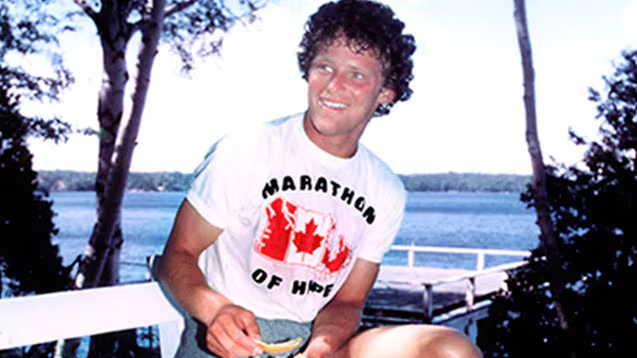
Terry Fox was more than just an athlete; he was a symbol of hope, determination, and incredible courage. Even though his life was cut short, his legacy continues to inspire millions of people around the world. This young Canadian man, faced with a devastating cancer diagnosis, decided to do something extraordinary. He embarked on a cross-country run, not for fame or glory, but to raise money and awareness for cancer research. His goal was simple yet profound: to create a world without cancer. This is the story of Terry Fox, a name synonymous with resilience and the power of one person to make a monumental difference. His journey, the Marathon of Hope, captured the heart of a nation and has left a lasting impact that grows stronger with each passing year.
Key Takeaways
- A Personal Battle: Terry Fox was diagnosed with osteosarcoma, a type of bone cancer, at just 18 years old, which led to the amputation of his right leg.
- The Marathon of Hope: In 1980, Terry began a cross-Canada run, called the Marathon of Hope, to raise money for cancer research. He ran close to a marathon (26.2 miles) every single day on a prosthetic leg.
- Incredible Feat: He ran for 143 consecutive days, covering 3,339 miles (5,373 kilometers) before cancer spread to his lungs, forcing him to stop.
- Lasting Legacy: Though he did not finish his run, he raised millions of dollars. The annual Terry Fox Run, held in communities worldwide, continues his mission, having raised over $850 million for cancer research.
- A National Hero: Terry Fox is celebrated as one of Canada’s greatest heroes, embodying perseverance, selflessness, and unwavering optimism.
Who Was Terry Fox?
Terrance Stanley Fox, known to the world as Terry Fox, was born on July 28, 1958, in Winnipeg, Manitoba, Canada. He grew up in Port Coquitlam, British Columbia, a suburb of Vancouver, as a determined and competitive young man. From an early age, Terry had a passion for sports. He loved basketball and was known for his incredible work ethic. Though he wasn’t the most naturally gifted player on his high school team, he made up for it with sheer persistence, earning a starting spot through hard work. His coach told him that if he wanted to succeed, he had to work harder than anyone else, and Terry took that advice to heart in everything he did. This tenacity would become the defining characteristic of his life. After high school, he attended Simon Fraser University to study kinesiology, with dreams of becoming a physical education teacher.
The Diagnosis That Changed Everything
In 1977, at the age of 18, Terry’s life took an unexpected and devastating turn. After a minor car accident, he felt a persistent pain in his right knee. Initially dismissed as a simple injury, the pain worsened. He was eventually diagnosed with osteosarcoma, a rare and aggressive form of bone cancer. The doctors told him that his best chance for survival was to amputate his right leg above the knee. The night before his surgery, Terry read an article about an amputee who had competed in the New York City Marathon. This story planted a seed of an idea in his mind. During his grueling months of chemotherapy, he witnessed the suffering of other cancer patients, especially children. He felt a deep sense of purpose and decided he had to do something to help end the pain he saw around him.
The Marathon of Hope: An Audacious Goal
Fueled by his experiences in the cancer ward, Terry Fox conceived a plan that was both simple and incredibly ambitious: he would run across Canada to raise money for cancer research. He named his journey the “Marathon of Hope.” His goal was to raise one dollar for every Canadian, which at the time amounted to about $24 million. He wasn’t just planning a casual jog; he intended to run approximately 26 miles—the length of a standard marathon—every single day. He would do this with one healthy leg and one prosthetic leg, a feat that had never been attempted. His unique running style, a combination of a hop and a skip, was physically demanding and often painful. Yet, his determination was unshakable. He believed that if he pushed himself to the absolute limit, he could inspire others to contribute to the cause.
Preparing for the Unimaginable
Training for the Marathon of Hope was a monumental task. For over a year, Terry Fox dedicated himself to a rigorous training regimen. He ran thousands of miles, building his stamina and getting used to the immense physical strain of running on a prosthesis. His artificial leg was a primitive device by today’s standards—a combination of steel and fiberglass that was heavy and unforgiving. It often caused sores, blisters, and bleeding. He worked with engineers to modify the prosthesis, but the pain was a constant companion. Despite the challenges, he ran in all weather conditions, pushing through pain and exhaustion. His best friend, Doug Alward, supported him throughout this period, driving alongside him and helping him prepare for the logistical challenges of a cross-country journey. By the time he was ready to begin, Terry had run over 3,000 miles in training alone.
The Journey Begins
On April 12, 1980, Terry Fox dipped his artificial leg into the Atlantic Ocean in St. John’s, Newfoundland. This symbolic act marked the official start of the Marathon of Hope. He filled two bottles with ocean water: one as a souvenir and the other with the intention of pouring it into the Pacific Ocean upon completing his run in Victoria, British Columbia. The early days of the run were difficult. The weather in Atlantic Canada was harsh, with freezing rain, strong winds, and even a snowstorm. Public attention was minimal, and donations were slow to come in. Many people didn’t understand what he was trying to accomplish. In those lonely first weeks, Terry faced not only physical hardship but also the emotional challenge of feeling like his efforts were going unnoticed. He and Doug lived out of a small van, and the journey was often isolating.
Gaining Momentum and Capturing a Nation’s Heart
Despite the slow start, Terry’s unwavering spirit began to capture people’s attention. As he ran through the small towns of the Maritime provinces and into Quebec, word of his incredible journey started to spread. The media began to cover his story, and crowds started to gather along the roadsides to cheer him on. People were moved by his humility and his raw determination. He wasn’t a celebrity or a professional athlete; he was an ordinary young man doing something truly extraordinary.
A Turning Point in Ontario
When Terry Fox reached Ontario, the Marathon of Hope transformed into a national phenomenon. His arrival in Toronto was a major event, with thousands of people lining the streets to greet him. He was met by dignitaries and celebrities, and donations began pouring in. The Canadian Cancer Society, which had been hesitant to support him at first, was now fully behind his cause. Businesses and communities organized massive fundraising events. The quiet, determined young man from British Columbia had become a national hero. He ran through sweltering summer heat, greeted by cheering crowds in every town he passed. His message was clear and powerful: “I’m not a dreamer, and I’m not saying this will initiate any kind of definitive answer or cure to cancer. But I believe in miracles. I have to.”
The Run’s Heartbreaking End
For 143 consecutive days, Terry Fox ran. He crossed Newfoundland, Prince Edward Island, Nova Scotia, New Brunswick, Quebec, and most of Ontario. He covered an astonishing 3,339 miles (5,373 kilometers). Through it all, the pain was relentless, but his spirit never wavered. However, on September 1, 1980, just outside of Thunder Bay, Ontario, his journey came to an abrupt and heartbreaking end. After experiencing intense coughing fits and chest pains, Terry was forced to stop running. He was taken to a hospital, where he learned that the cancer had returned and spread to his lungs. In an emotional press conference, he told a stunned nation, “I’ll do my best. I’ll fight. I promise I won’t give up.” He had to abandon his run, more than halfway to his goal.
The World Responds
The news that Terry had been forced to stop his run devastated Canadians, but it also galvanized them into action. In a massive outpouring of support, a national telethon was organized, raising millions of dollars in a matter of hours. By February 1981, Terry’s initial goal of $24 million had been met. He watched from his hospital bed as the country he had inspired rallied to finish what he had started. His courage in the face of his own declining health was just as inspiring as his run had been. He received letters and well-wishes from people all over the world, including the Pope. His bravery had touched a global audience, solidifying his place as a true hero. His story is a testament to what one person can achieve, a topic often explored on platforms like forbesplanet.co.uk that celebrate human achievement.
The Legacy of Terry Fox
On June 28, 1981, after a courageous battle, Terry Fox passed away, one month shy of his 23rd birthday. Though his life was short, his legacy is immeasurable. He did not get to finish his run across Canada, but he had ignited a movement that would continue long after he was gone. Before his death, he had resisted the idea of an annual run in his name, as he didn’t want anyone to think he was seeking personal glory. However, he eventually agreed to the creation of the Terry Fox Run, an event that would be non-competitive, all-inclusive, and continue to raise funds for cancer research. He wanted it to be a day where families could come together to walk, run, or bike in his memory.
The Annual Terry Fox Run
The first Terry Fox Run was held on September 13, 1981, in more than 760 locations across Canada and around the world. Over 300,000 people participated, raising $3.5 million. Since then, it has become an annual tradition. Every September, millions of people in over 60 countries participate in the Terry Fox Run, making it the world’s largest single-day fundraiser for cancer research. The events are organized by volunteers and stay true to Terry’s original vision: there are no entry fees, no minimum pledge amounts, and no corporate sponsorships on the event t-shirts. The focus remains squarely on raising money to find a cure for cancer. To date, the Terry Fox Foundation has raised over $850 million, funding groundbreaking research projects that have improved cancer treatments and saved countless lives.
An Enduring Symbol of Hope
Terry’s impact extends far beyond the money raised. He has become a permanent part of Canada’s national identity. Schools are named after him, statues have been erected in his honor, and his story is a mandatory part of the curriculum for Canadian children. He is a symbol of courage, selflessness, and the power of one person to make a difference. His story teaches us that even when faced with insurmountable odds, we can choose to act with hope and purpose. The Marathon of Hope was not a failure because it was unfinished; it was a resounding success because it inspired a global movement that continues to this day. The example set by Terry Fox reminds us that true heroism lies in fighting for a cause greater than oneself.
| Event Timeline of the Marathon of Hope |
| :————————————- | :——————————————————————————————————– |
| April 12, 1980 | Terry Fox begins the Marathon of Hope in St. John’s, Newfoundland. |
| May 1980 | Runs through the Maritime provinces, facing harsh weather and low public awareness. |
| June 28, 1980 | Arrives in Montreal, Quebec, where support begins to grow significantly. |
| July 11, 1980 | Runs into Toronto, Ontario, greeted by thousands of supporters, marking a major turning point for the run. |
| August 1980 | Continues through the grueling summer heat of Southern Ontario, becoming a national celebrity. |
| September 1, 1980 | After running 3,339 miles, Terry is forced to stop near Thunder Bay, Ontario, as cancer spreads to his lungs. |
| September 2, 1980 | Terry Fox officially ends his run and flies home for treatment. |
| February 1, 1981 | The Marathon of Hope fund reaches its goal of $24.1 million. |
| June 28, 1981 | Terry Fox passes away at the age of 22. |
| September 13, 1981 | The first annual Terry Fox Run is held worldwide, continuing his legacy. |
Conclusion
The story of Terry Fox is a powerful reminder that an ordinary person can achieve the extraordinary. He was a young man who, when faced with his own mortality, chose not to retreat but to launch a mission of hope for millions. His Marathon of Hope was a journey of incredible physical endurance and even greater spirit. Though he did not complete his cross-country run, he accomplished something far more significant: he united a nation, initiated a global fundraising movement, and created a legacy of hope that continues to fund vital cancer research. Terry’s determination, humility, and unwavering optimism in the face of immense personal struggle have made him an enduring icon of courage. His life proves that one person’s dream, fueled by purpose and passion, can indeed change the world.
Frequently Asked Questions (FAQs)
1. How old was Terry Fox when he died?
Terry Fox passed away on June 28, 1981, just one month before his 23rd birthday.
2. How much money did Terry Fox raise initially?
When Terry Fox was forced to stop his run on September 1, 1980, he had raised approximately $1.7 million. However, a nationally televised telethon shortly after raised an additional $10 million, and by February 1981, donations had surpassed his goal of $24 million.
3. What kind of cancer did Terry Fox have?
Terry Fox was diagnosed with osteosarcoma, a type of bone cancer that most often occurs in young people. It was this diagnosis that led to the amputation of his right leg and inspired his Marathon of Hope.
4. How far did Terry Fox run?
Terry Fox ran for 143 consecutive days, covering a distance of 3,339 miles (5,373 kilometers). He ran through six Canadian provinces before cancer spread to his lungs and forced him to stop.
5. Is the Terry Fox Run still happening?
Yes, the Terry Fox Run is held annually every September in communities across Canada and in over 60 countries around the world. It is a non-competitive event that continues to raise money for cancer research in his name, with over $850 million raised to date.
Related Posts



Stay Informed With the Latest & Most Important News
Previous Post
Next Post








Advertisement