

Now Reading: The Ultimate Guide to Adaptive Network Control
-
01
The Ultimate Guide to Adaptive Network Control


In our highly connected world, networks are the invisible backbone of everything we do, from streaming movies to running global businesses. But what happens when these networks get overloaded or face unexpected changes? Traditionally, managing network traffic has been a manual and reactive process. Today, a smarter solution is changing the game: adaptive network control. This technology allows networks to think for themselves, automatically adjusting to changing conditions to ensure smooth, efficient, and reliable performance. It’s like giving your network a brain, enabling it to respond to challenges in real-time without a human operator needing to intervene.
This guide will explore the fascinating world of adaptive network control. We will break down what it is, how it works, and why it has become so crucial for modern digital infrastructure. Whether you’re a tech enthusiast, a business owner, or just curious about the technology that powers our daily lives, you’ll gain a clear understanding of this transformative field. We’ll cover its core principles, real-world applications, and the exciting future it promises for everything from 5G to the Internet of Things (IoT).
Key Takeaways
- What is Adaptive Network Control?: It’s an intelligent approach to network management where the network automatically adjusts its performance, routing, and resource allocation based on real-time conditions.
- Why It Matters: It improves network efficiency, enhances user experience by reducing lag, strengthens security, and lowers operational costs.
- Core Components: Key elements include monitoring tools, machine learning algorithms for analysis, and automated policy engines for execution.
- Real-World Impact: It is essential for managing traffic in 5G networks, IoT ecosystems, cloud computing environments, and autonomous vehicle communication.
- The Future is Automated: The evolution of adaptive network control is moving towards fully autonomous networks that can predict issues and heal themselves before they impact users.
What Exactly Is Adaptive Network Control?
At its heart, adaptive network control is a dynamic method of managing a computer network. Unlike traditional network management, which relies on static, pre-configured rules, adaptive systems are built to be flexible. They constantly monitor the network’s health, traffic patterns, and performance metrics. When they detect a change—like a sudden surge in users, a hardware failure, or a security threat—they automatically adjust the network’s settings to handle the situation optimally.
Think of it like the traffic control system in a smart city. A basic system uses fixed timers for traffic lights. A smarter, adaptive system uses sensors to detect traffic buildup and changes the light timings in real time to keep cars moving smoothly. Adaptive network control does the same thing, but for data packets traveling across digital highways. It ensures that your video call doesn’t freeze, your online game doesn’t lag, and your critical business applications always have the bandwidth they need.
The Shift from Static to Dynamic Management
For decades, network administrators managed their environments manually. They would set rules for data prioritization and traffic routing based on predicted usage. If something unexpected happened, an administrator would have to log in, diagnose the problem, and apply a fix. This approach is slow, prone to human error, and simply can’t keep up with the complexity and scale of modern networks.
The rise of cloud computing, streaming services, and the Internet of Things has made network traffic incredibly unpredictable. An adaptive network control system replaces this manual, reactive model with an automated, proactive one. It uses sophisticated algorithms to make intelligent decisions on the fly, ensuring the network is always running at peak performance. This shift is not just an upgrade; it’s a fundamental change in how we think about building and maintaining our digital infrastructure.
How Does Adaptive Network Control Work?
The magic behind adaptive network control lies in a continuous, three-step feedback loop: Monitor, Analyze, and Act. This cycle runs constantly, allowing the network to respond to changes in milliseconds. Let’s break down each stage to understand the process.
Stage 1: Continuous Monitoring and Data Collection
The first step is visibility. An adaptive network can’t manage what it can’t see. Therefore, it uses a wide array of tools to collect vast amounts of data from every corner of the network. This includes:
- Traffic Volume: How much data is flowing through different parts of the network?
- Latency: How long does it take for data packets to travel from source to destination?
- Packet Loss: Are any data packets being dropped along the way?
- Bandwidth Utilization: Which connections are nearing their capacity limits?
- Application Performance: Are specific applications (like video conferencing or databases) performing as expected?
- Device Health: Are routers, switches, and servers functioning correctly?
This data provides a live, comprehensive picture of the network’s current state. Without accurate and timely monitoring, the entire adaptive process would fail.
Stage 2: Intelligent Analysis with AI and Machine Learning
Once the data is collected, it needs to be analyzed to find meaningful patterns and identify potential problems. This is where artificial intelligence (AI) and machine learning (ML) come into play. ML algorithms are trained on historical network data to understand what “normal” behavior looks like.
When a deviation from the norm occurs, the system can quickly identify it. For example, the algorithm might detect that latency on a specific path is slowly increasing, indicating a developing congestion issue. It can also predict future problems. By analyzing trends, an adaptive network control system might forecast a traffic spike based on the time of day or a popular live event, allowing it to prepare in advance. This predictive capability is what makes these systems so powerful and proactive.
Stage 3: Automated Action and Policy Enforcement
After the analysis identifies an issue or an opportunity for optimization, the system must act. An automation engine takes the insights from the analysis and translates them into concrete actions. These actions are based on a set of predefined policies established by network administrators.
Examples of automated actions include:
- Rerouting Traffic: If a primary data path becomes congested or fails, the system can instantly reroute traffic to a less crowded or more stable alternative path.
- Adjusting Bandwidth: The system can allocate more bandwidth to a high-priority application, like a CEO’s video conference, while temporarily limiting bandwidth for less critical activities.
- Blocking Security Threats: If the system detects suspicious traffic patterns indicative of a cyberattack, it can automatically block the malicious source to protect the network.
This entire loop—from monitoring to action—happens automatically and continuously, ensuring the network remains resilient and efficient 24/7.
The Core Components of an Adaptive Network
An effective adaptive network control system is built from several key technological components working in harmony. These components form the foundation that enables the network to perceive, reason, and respond to its environment.
1. Network Monitoring and Telemetry Tools
These are the eyes and ears of the network. Telemetry tools are deployed on routers, switches, and servers to stream real-time operational data to a central collection point. Modern telemetry is far more granular and faster than older methods like SNMP (Simple Network Management Protocol), providing deep insights into network health second by second.
2. A Centralized Control Plane
In traditional networks, each device (like a router) makes its own decisions. In an adaptive network, a centralized controller often oversees the entire environment. This approach, known as Software-Defined Networking (SDN), decouples the control logic from the physical hardware. The SDN controller has a complete view of the network, which allows it to make more intelligent and coordinated decisions for traffic management across all devices.
3. The Analytics and Machine Learning Engine
This is the brain of the operation. The analytics engine ingests the telemetry data and uses machine learning models to process it. It’s responsible for:
- Anomaly Detection: Spotting unusual behavior that could signal a problem.
- Predictive Analytics: Forecasting future network states based on current trends.
- Root Cause Analysis: Helping to diagnose the underlying cause of a problem instead of just treating symptoms.
This engine provides the intelligence that transforms raw data into actionable insights.
4. The Policy and Automation Engine
This component acts as the hands of the system. It takes the recommendations from the analytics engine and executes them according to predefined rules, or policies. For instance, a policy might state: “If latency for the ‘VoIP‘ application exceeds 50ms, find an alternative route with lower latency.” The automation engine is responsible for carrying out these commands automatically, without human intervention. This ensures consistent and rapid responses to network events.
Key Benefits of Implementing Adaptive Network Control
Adopting adaptive network control isn’t just about embracing new technology; it’s about unlocking tangible business benefits. From cost savings to happier customers, the advantages are significant and wide-ranging.
Enhanced Performance and User Experience
For users, network performance is all about speed and reliability. Adaptive networks directly improve this experience by minimizing latency and preventing bottlenecks. By proactively managing traffic, they ensure that video streams don’t buffer, web pages load instantly, and cloud applications remain responsive. This leads to higher user satisfaction and productivity, whether for employees in a large enterprise or customers using a web service.
Increased Network Resilience and Uptime
Things go wrong in any complex system. Hardware can fail, fiber optic cables can be cut, and software can have bugs. An adaptive network control system builds resilience by automatically detecting and routing around failures. If a primary link goes down, traffic is seamlessly shifted to a backup path, often so quickly that users don’t even notice a disruption. This self-healing capability dramatically increases network uptime and ensures business continuity.
Improved Security Posture
Modern cyberattacks are fast and sophisticated. A manual defense is often too slow to stop them. Adaptive networks can play a crucial role in security by identifying and mitigating threats in real time. For example, if the system detects a Distributed Denial of Service (DDoS) attack, where an attacker floods the network with junk traffic, it can automatically filter and block the malicious traffic at the network edge before it can impact critical services.
Lower Operational Costs
Automating network management frees up skilled IT professionals from routine, time-consuming tasks. Instead of constantly firefighting network issues, they can focus on more strategic initiatives that add business value. Automation also reduces the risk of human error, which can lead to costly outages. Over time, the efficiency gains and improved stability provided by adaptive network control can lead to a significant reduction in operational expenditures (OpEx).
Real-World Applications of Adaptive Network Control
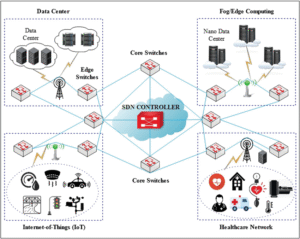
The principles of adaptive network control are being applied across various industries and technologies, solving some of the most pressing challenges in modern connectivity.
Telecommunications and 5G Networks
5G networks promise ultra-low latency and massive bandwidth, but they also introduce immense complexity. These networks must support a diverse range of applications, from high-speed mobile broadband to mission-critical IoT devices. Adaptive network control is essential for managing this complexity through a technique called “network slicing.” This allows operators to create multiple virtual networks on top of a single physical infrastructure, each slice tailored with specific characteristics (e.g., a low-latency slice for autonomous cars and a high-bandwidth slice for video streaming).
Cloud Computing and Data Centers
The largest data centers in the world, run by companies like Google, Amazon, and Microsoft, handle an unimaginable amount of traffic. They rely heavily on adaptive networking to balance loads across thousands of servers, manage traffic between data centers, and ensure their cloud services are always available and performant. When you use a cloud application, adaptive control is working behind the scenes to give you a smooth experience.
The Internet of Things (IoT)
The IoT involves connecting billions of devices, from smart home sensors to industrial machinery. Many of these devices generate small but constant streams of data. An adaptive network control system can efficiently manage this unique traffic pattern, ensuring that critical alerts (like a security sensor being tripped) are prioritized over routine data transmissions. It also helps manage the power consumption of battery-operated devices by optimizing their network communication schedules.
Autonomous Vehicles
Self-driving cars require constant, ultra-reliable communication with each other and with roadside infrastructure (Vehicle-to-Everything or V2X communication). A delay of even a few milliseconds could be catastrophic. Adaptive network control is critical for ensuring these vehicle networks have guaranteed low latency and high reliability. The network must be able to instantly adapt to changing road conditions, signal strength, and vehicle density to maintain safety.
The Challenges and Considerations of Adoption
While the benefits are clear, implementing adaptive network control is not without its challenges. Organizations must consider several factors before embarking on this journey.
Complexity and Skill Gap
These systems are inherently complex, blending networking, software development, and data science. There is currently a shortage of IT professionals with the hybrid skills needed to design, deploy, and manage adaptive networks. Organizations need to invest in training their existing staff or hire new talent with expertise in areas like network automation and AI/ML.
Integration with Legacy Systems
Most organizations have existing network infrastructure that may not be compatible with modern adaptive control technologies. Integrating new, software-defined systems with older, legacy hardware can be a significant technical hurdle. A phased approach, where adaptive capabilities are introduced gradually, is often the most practical strategy.
Trust in Automation
For many network administrators, handing over control to an automated system can be a daunting prospect. Building trust in the system’s decisions is crucial. This often involves starting with the system in a “recommendation mode,” where it suggests changes that a human operator must approve. As the team gains confidence in the AI’s accuracy, they can gradually move towards full automation.
Security of the Controller Itself
In an adaptive network, the central controller is a powerful tool. It also represents a high-value target for attackers. If the controller is compromised, an attacker could potentially bring down the entire network. Therefore, securing the control plane with robust access controls, encryption, and monitoring is an absolute top priority.
The Future of Networking: Towards Autonomous Systems
The journey of adaptive network control is heading towards an even more advanced destination: the fully autonomous network. This is a network that can manage itself entirely, from configuration and optimization to defense and repair, with minimal human oversight.
Key Characteristics of an Autonomous Network
|
Feature |
Description |
|---|---|
|
Self-Configuring |
The network can automatically configure new devices and services as they are added. |
|
Self-Optimizing |
It continuously fine-tunes its performance to meet the demands of applications and users. |
|
Self-Healing |
The network can detect, diagnose, and fix problems on its own, often before users are affected. |
|
Self-Protecting |
It can proactively identify and defend against security threats in real time. |
This vision, often referred to as a “self-driving network,” leverages even more advanced AI to move from reactive and proactive control to fully predictive and prescriptive management. For deeper insights into emerging tech trends, you can explore resources like those available at Forbes Planet, which often covers the intersection of technology and business.
Intent-Based Networking (IBN)
A key stepping stone towards autonomous networking is Intent-Based Networking (IBN). With IBN, administrators don’t configure specific network rules. Instead, they declare their business intent. For example, an admin might state, “Ensure high-quality video calls for the executive team.” The IBN system then automatically translates this high-level intent into the necessary network policies and configurations to achieve the desired outcome. This abstracts away the complexity and allows IT to focus on business goals rather than low-level network mechanics.
Conclusion
The era of static, manually managed networks is drawing to a close. The sheer scale, dynamism, and complexity of modern digital demands require a more intelligent and automated approach. Adaptive network control provides this solution, transforming networks from rigid, fragile systems into flexible, resilient, and self-optimizing platforms. By harnessing the power of real-time monitoring, AI-driven analytics, and automated action, these networks can deliver superior performance, stronger security, and greater operational efficiency.
While challenges in implementation remain, the trajectory is clear. As technology continues to evolve, we are moving ever closer to the vision of a truly autonomous, self-driving network. For businesses and users alike, this means a future of more reliable, secure, and seamless connectivity that powers innovation and enables new possibilities we are only just beginning to imagine.
Frequently Asked Questions (FAQ)
Q1: What is the main difference between adaptive network control and traditional network management?
The main difference is the shift from static, manual control to dynamic, automated control. Traditional management relies on fixed rules set by administrators. Adaptive network control uses AI and automation to continuously monitor the network and adjust its behavior in real time based on current conditions.
Q2: Is adaptive network control the same as Software-Defined Networking (SDN)?
Not exactly, but they are closely related. SDN is an architectural approach that separates the network’s control plane from its data plane, which is a key enabler for adaptive control. You can think of SDN as the foundation, and adaptive network control as the intelligence and automation built on top of that foundation.
Q3: Can small businesses benefit from adaptive network control?
Yes, absolutely. While large enterprises were the first adopters, the technology is becoming more accessible. Many modern Wi-Fi systems for small businesses incorporate adaptive features, such as automatically switching channels to avoid interference or prioritizing video call traffic. As cloud-managed networking becomes more common, adaptive capabilities will become standard for businesses of all sizes.
Q4: How does machine learning help in adaptive networking?
Machine learning is the “brain” of an adaptive network. Its algorithms analyze vast amounts of network data to learn normal behavior, detect anomalies that signal problems, predict future traffic patterns, and recommend optimal configurations. Without ML, the system would not be able to make intelligent, data-driven decisions.
Q5: Is implementing adaptive network control a difficult process?
It can be complex, as it requires new skills and careful integration with existing systems. However, vendors are increasingly offering solutions that simplify deployment. Many organizations start with a phased approach, automating one part of the network at a time to build experience and trust in the system before moving to full-scale automation.
Stay Informed With the Latest & Most Important News
Previous Post
Next Post











Advertisement