

Now Reading: A Complete Guide to GTAW Welding (TIG)
-
01
A Complete Guide to GTAW Welding (TIG)

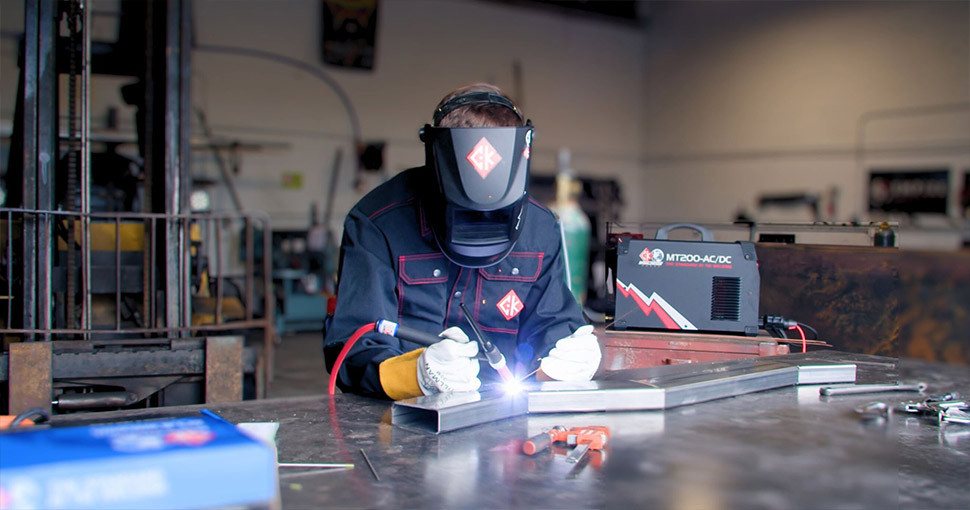
Have you ever looked at a perfectly smooth, clean metal weld and wondered how it was made? Chances are, it was created using a process known as GTAW welding, or Gas Tungsten Arc Welding. More commonly called TIG welding, this technique is famous for producing strong, high-quality, and visually appealing welds on a wide range of metals. It requires skill and precision, but the results are truly unmatched.
This guide will walk you through everything you need to know about the world of GTAW welding. We will explore what it is, how it works, the equipment you’ll need, and the pros and cons of this popular welding method. Whether you’re a student, a hobbyist, or a professional looking to expand your skills, you’ll find valuable insights here. Let’s dive in and uncover the art and science behind GTAW welding.
Key Takeaways
- Precision and Quality: GTAW welding is renowned for producing exceptionally clean, strong, and precise welds, making it ideal for applications where appearance and integrity are critical.
- Versatility: This process can be used to weld a wide variety of metals, including aluminum, stainless steel, magnesium, copper, and titanium.
- Complex Process: GTAW welding requires a high level of skill and coordination from the operator, as it involves feeding filler metal with one hand while manipulating the torch with the other.
- Essential Equipment: A complete setup includes a constant current power source, a welding torch, a non-consumable tungsten electrode, shielding gas, and filler metal.
- Safety is Paramount: Proper personal protective equipment (PPE) is non-negotiable due to exposure to intense UV light, high temperatures, and fumes.
What Exactly is GTAW Welding?
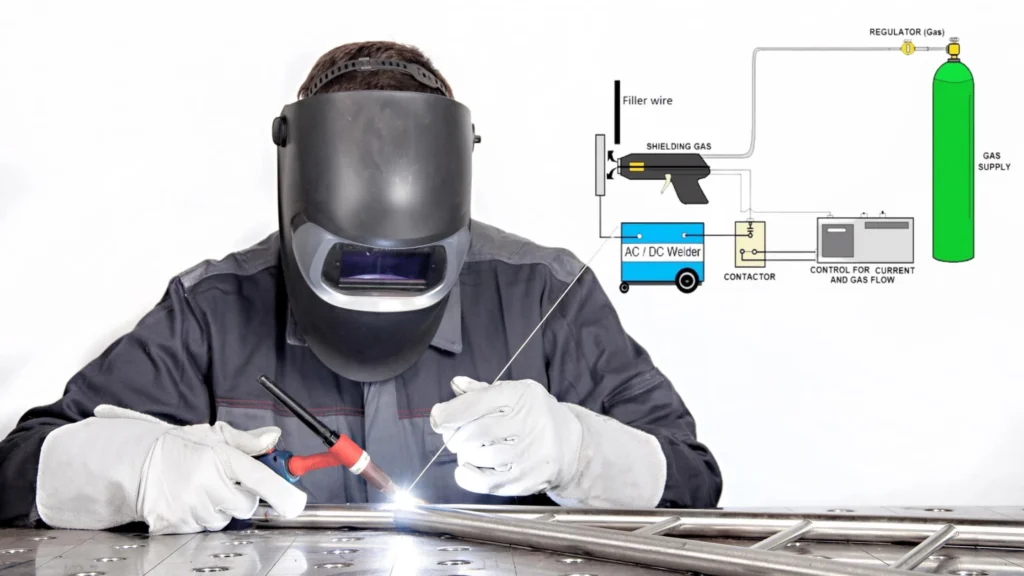
GTAW welding stands for Gas Tungsten Arc Welding. While that might sound technical, the common name for it is TIG, which stands for Tungsten Inert Gas welding. This name gives a clearer picture of how it works. In this process, a welding torch creates an electric arc between a non-consumable tungsten electrode and the metal piece you are welding. This arc generates intense heat, which melts the base metal to form a molten weld pool. To protect this pool from contamination by oxygen and other gases in the air, a shielding gas (usually an inert gas like argon or helium) flows from the torch and covers the weld area. Unlike some other welding methods, GTAW welding doesn’t always require a filler material. For thin metals, you can simply fuse two pieces together. However, for thicker joints, the welder manually feeds a filler rod into the weld pool to add material and create a stronger bond.
The History and Evolution of GTAW Welding
The roots of GTAW welding trace back to the early 20th century, with significant developments occurring around the 1940s. The need to weld challenging materials like aluminum and magnesium alloys for the aircraft industry during World War II spurred its invention. Initially, welding these reactive metals was difficult because they would oxidize quickly when exposed to air at high temperatures, resulting in weak and porous welds. Russell Meredith of Northrop Aircraft developed the process in 1941, originally naming it Heliarc because he used helium as the shielding gas. This new method, using a tungsten electrode and an inert gas shield, was revolutionary. It allowed for strong, clean welds on non-ferrous metals, which was a massive breakthrough for aerospace and other critical industries. Over the years, the process was refined with the introduction of argon as a more common shielding gas, the development of more advanced power sources with features like high-frequency start and AC balance control, and improvements in torch design.
The Core Components of a GTAW Welding Setup
To get started with GTAW welding, you need several key pieces of equipment. Each component plays a crucial role in ensuring a successful and high-quality weld. Understanding what each part does is fundamental to mastering the process.
1. The Welding Power Source
The heart of any GTAW welding station is the power source. For this process, you need a constant current (CC) machine. These power sources maintain a stable amperage level even if the distance between the electrode and the workpiece (the arc length) varies slightly. This stability is critical for the control and precision that TIG welding is known for. These machines can supply either Direct Current (DC) or Alternating Current (AC). DC is typically used for welding steel, stainless steel, and copper, while AC is essential for welding aluminum and magnesium. Modern inverter-based machines are popular because they are lightweight, more energy-efficient, and often come packed with advanced features like pulse control and high-frequency start.
2. The Welding Torch
The GTAW torch is what the welder holds to control the arc and direct the heat. It’s a carefully designed tool with several parts. The torch body houses the collet, which grips the tungsten electrode firmly in place. A ceramic or alumina cup, known as a gas nozzle, screws onto the end of the torch head. This cup directs the flow of shielding gas over the weld area. Torches come in two main types: air-cooled and water-cooled. Air-cooled torches are simpler and sufficient for lower amperage applications (typically under 200 amps). For high-amperage, heavy-duty welding, water-cooled torches are necessary to prevent overheating. They have additional lines that circulate coolant through the torch head to keep it at a safe operating temperature.
3. The Non-Consumable Tungsten Electrode
Unlike in MIG or stick welding, the electrode in GTAW welding is considered non-consumable. This means it is not meant to melt and become part of the weld. Instead, its job is to carry the electrical current and establish the arc. These electrodes are made of tungsten or a tungsten alloy because tungsten has an extremely high melting point (6,192°F or 3,422°C). Tungsten electrodes come in various types, identified by a color band.
|
Tungsten Type |
Color Band |
Primary Use |
|---|---|---|
|
Pure Tungsten (EWP) |
Green |
AC welding on aluminum and magnesium. |
|
2% Thoriated (EWTh-2) |
Red |
DC welding on steels and stainless steels. |
|
2% Ceriated (EWCe-2) |
Orange |
Excellent for both AC and DC applications. |
|
1.5% Lanthanated |
Gold |
All-purpose, good for AC and DC. |
|
Zirconiated (EWZr-1) |
Brown |
AC welding, highly resistant to spitting. |
Note: Thoriated tungsten (red) is slightly radioactive and precautions should be taken, especially during grinding, to avoid inhaling the dust.
4. The Shielding Gas
The “G” in GTAW stands for gas, and it’s essential for protecting the molten weld from the atmosphere. Oxygen, nitrogen, and hydrogen in the air can cause defects like porosity and embrittlement, ruining the weld’s integrity. An inert gas is used to create a protective bubble around the arc and weld pool. The most common shielding gas for GTAW welding is argon. It is a great all-purpose gas that provides excellent arc stability and cleaning action. For thicker sections or metals with high thermal conductivity like aluminum and copper, a helium/argon mix or pure helium can be used. Helium produces a hotter arc, allowing for deeper penetration and faster travel speeds. The gas is stored in high-pressure cylinders and delivered to the torch through a regulator and flowmeter.
5. The Filler Metal
For many GTAW welding applications, especially when joining thicker pieces of metal or filling a gap, a filler metal is required. This is a separate rod or wire that the welder manually feeds into the molten weld pool with their non-torch hand. The filler metal must be compatible with the base metals being joined to ensure a strong and durable bond. For example, when welding 304 stainless steel, you would use a 308L filler rod. Similarly, an ER70S-2 rod is common for mild steel, and a 4043 or 5356 rod is used for aluminum. The filler rod is not just for adding material; it also helps control the weld pool’s temperature and composition, influencing the final mechanical properties of the weld.
The Pros and Cons of GTAW Welding
Like any manufacturing process, GTAW welding has its own set of advantages and disadvantages. Understanding these helps in deciding when it is the right choice for a project.
Advantages of GTAW Welding
The biggest advantage is the superior quality and appearance of the welds. The process allows for excellent control over the weld pool, resulting in neat, clean, and precise weld beads that often require no post-weld cleaning. This makes it a favorite for applications where aesthetics are important, such as in custom automotive fabrication or architectural metalwork.
Another major benefit is its versatility. GTAW welding can be used on a wider range of metals than most other welding processes, including stainless steel, aluminum, magnesium, nickel alloys, titanium, and copper. It can also be used to weld very thin materials, something that is difficult with other methods like stick or MIG welding. Since it uses a separate filler rod, the welder has precise control over how much material is added, which helps prevent burn-through on delicate parts. Finally, the process is very clean, producing no spatter and minimal smoke or fumes compared to other arc welding techniques.
Disadvantages of GTAW Welding
The primary drawback of GTAW welding is its slow travel speed. Because the process is so deliberate and often involves manually feeding a filler rod, it is significantly slower than MIG or stick welding. This makes it less suitable for large-scale production where speed is a top priority.
Furthermore, GTAW welding has a steep learning curve. It requires a high degree of hand-eye coordination and ambidexterity, as the welder must maintain a consistent arc length with one hand while feeding the filler rod with the other, all while potentially operating a foot pedal to control the amperage. This complexity means that it takes a lot more practice to become proficient compared to, for example, MIG welding. The equipment is also typically more expensive and complex than that for other common welding processes.
Common Applications for GTAW Welding
Given its unique characteristics, GTAW welding is the go-to process for a variety of critical and high-precision applications. You will find it used extensively in industries where weld quality and integrity are non-negotiable.
Aerospace and Aviation
The aerospace industry was one of the first to adopt GTAW welding, and it remains a cornerstone of aircraft manufacturing and repair. The process is used to weld critical components like engine parts, airframes, and landing gear made from high-strength aluminum, titanium, and nickel-based superalloys. The precision and defect-free results provided by TIG are essential for ensuring the safety and reliability of aircraft.
Food and Beverage Industry
In the food, dairy, and pharmaceutical industries, cleanliness is paramount. Tubing, tanks, and processing equipment are often made from stainless steel and must have perfectly smooth interior surfaces to prevent bacteria from accumulating. GTAW welding is used to create these smooth, crevice-free welds. The process known as orbital welding, which is an automated form of GTAW, is often used for joining sanitary tubing to ensure perfect consistency and quality.
Automotive and Motorsports
From high-end exhaust systems to custom roll cages and chassis components, GTAW welding is prevalent in the automotive world. Its ability to create strong, lightweight, and visually stunning welds on materials like chromoly, stainless steel, and aluminum makes it ideal for performance applications. Custom fabricators and race teams rely on TIG welding for parts that need to withstand extreme stress while looking incredible.
Safety Precautions for GTAW Welding
Safety should always be the top priority when performing any type of welding. The GTAW welding process presents several hazards that you must protect yourself from.
The arc produced during TIG welding is extremely bright and emits intense ultraviolet (UV) and infrared (IR) radiation. Looking at the arc without proper eye protection, even for a split second, can cause a painful condition called “arc flash” or “welder’s flash,” which is like a sunburn on your corneas. Always wear a welding helmet with an auto-darkening lens or a fixed-shade lens of at least a #10 shade. This radiation can also burn your skin, so wearing long-sleeved, flame-resistant clothing is essential.
High temperatures are another obvious hazard. The arc and the molten metal can cause severe burns. Always wear dry, insulated welding gloves to protect your hands. The process can also produce fumes and gases, especially when welding on coated or dirty metals. Ensure you are working in a well-ventilated area or use a fume extraction system to keep your breathing air clean. Finally, since it’s an electrical process, be mindful of shock hazards. Keep your equipment well-maintained and your work area dry. Proper knowledge of safety protocols is crucial, and you can find comprehensive resources on sites like https://forbesplanet.co.uk/ that cover workplace safety in depth.
Conclusion
GTAW welding is a highly skilled and versatile process that holds a special place in the world of metal fabrication. Its ability to produce welds of unparalleled quality, precision, and beauty makes it an indispensable technique in critical industries like aerospace, as well as for artisans and craftsmen who take pride in their work. While it may be slower and more challenging to learn than other methods, the mastery of GTAW welding opens up a world of possibilities, allowing you to work with a vast array of materials and create joints that are as strong as they are clean. By understanding the equipment, practicing the techniques, and always prioritizing safety, you can harness the power of this amazing process to bring your metalworking projects to the next level.
Frequently Asked Questions (FAQ)
What is the main difference between TIG (GTAW) and MIG (GMAW) welding?
The main difference lies in the electrode and filler metal delivery. In GTAW welding (TIG), you use a non-consumable tungsten electrode to create the arc, and you manually feed a separate filler rod into the weld pool. In MIG welding (GMAW), the electrode is a continuously fed wire that melts and becomes the filler metal itself. This makes MIG much faster, but TIG offers more precision and control.
Can you use GTAW welding on all types of metal?
GTAW is one of the most versatile welding processes and can be used on a very wide range of metals. This includes various types of steel, stainless steel, aluminum, magnesium, copper, bronze, nickel alloys, and titanium. The key is to use the correct power source settings (AC or DC), shielding gas, and filler metal for the specific material you are welding.
Do I always need to use a filler rod with GTAW welding?
No, you do not always need a filler rod. For joining very thin pieces of metal where the edges are fit together perfectly, you can perform what is called an “autogenous weld.” This is where you simply melt the edges of the base metals and allow them to fuse together without adding any extra material. This technique is common for welding thin sheet metal or tubing.
Why is AC current used for welding aluminum?
When welding aluminum with GTAW welding, you use Alternating Current (AC). Aluminum naturally forms a tough, high-melting-point layer of aluminum oxide on its surface. The DC electrode positive (EP) portion of the AC cycle provides a “cleaning action” that blasts away this oxide layer, while the DC electrode negative (EN) portion provides the heat needed to melt the base metal underneath. This cleaning/heating cycle is essential for creating a sound aluminum weld.
What is the hardest part about learning GTAW welding?
For most beginners, the hardest part is the coordination required. You must maintain a very short and consistent arc length with the torch in one hand, while simultaneously feeding the filler rod into the weld pool with your other hand. Many setups also use a foot pedal to control the amperage, adding another layer of complexity. It’s like patting your head, rubbing your stomach, and tapping your foot all at the same time. However, with practice, it becomes second nature.
Stay Informed With the Latest & Most Important News
Previous Post
Next Post











Advertisement